

By Rebecca Ekpe
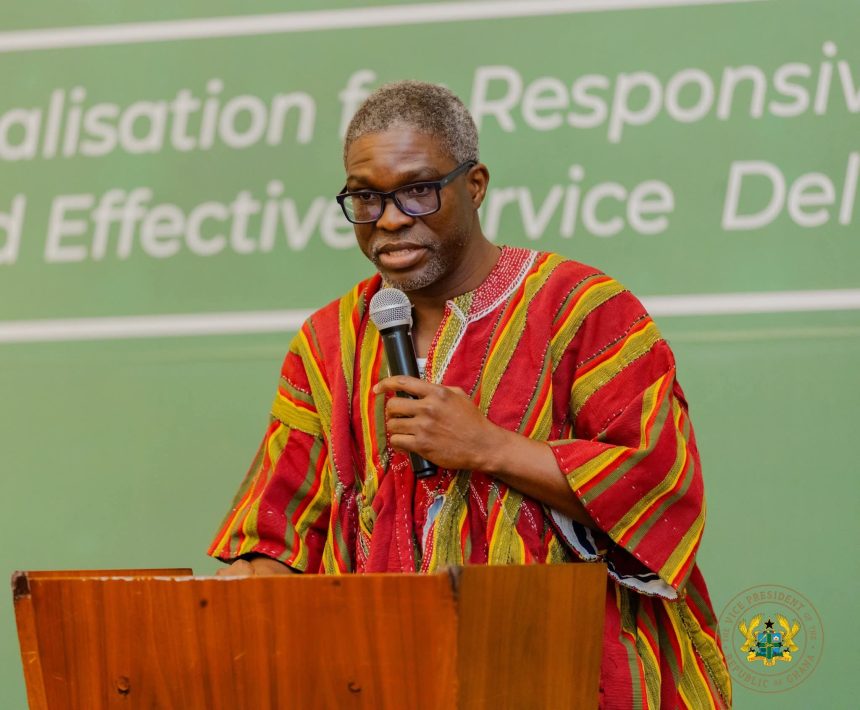
“Decentralization must move from an abstract aspiration to a reality that reshapes service delivery and how citizens experience government in their everyday lives.”
— Prof. Naana Jane Opoku-Agyemang, Vice President of Ghana, National Dialogue on Decentralization and Responsive Governance, 2025.
Ghana’s democratic journey has often been celebrated for its relative stability, regular elections and peaceful transfers of political power. However, the strength of a democracy cannot be measured only by the conduct of national elections. A truly responsive democracy must also provide citizens with meaningful opportunities to participate in decisions that affect their daily lives. There is continuous debate about how responsive is Ghana’s democracy to the needs of its people?
Related Stories

This is where decentralization becomes particularly important.
Decentralization is fundamentally about transferring certain political, administrative and developmental responsibilities from central government to local authorities, allowing decisions to be taken closer to the people. In Ghana, the system is anchored in the local government structure, particularly the Metropolitan, Municipal and District Assemblies (MMDAs).
The underlying principle is straightforward: people who live in communities are often best placed to identify the challenges confronting those communities and to contribute to determining the solutions.
For Ghana, therefore, decentralization is not merely an administrative arrangement. It is an important instrument for deepening democracy, improving accountability, strengthening citizen participation and promoting development at the grassroots.
At the 2025 National Dialogue, the Executive Secretary of the Inter-Ministerial Coordinating Committee on Decentralization stressed that decentralization is “not self-executing.” He said it requires careful design, political will, commitment and continuous adaptation, while calling for practical solutions that bring government closer to citizens, improve service delivery and transform communities.
Taking Democracy Beyond Elections
One of the greatest contributions decentralization can make to Ghana’s democratic dispensation is to take democracy beyond the ballot box.
National elections give citizens the opportunity to choose political leaders, but democracy should not end once votes have been counted. Citizens must continue to have avenues through which they can influence decisions, express their concerns and hold public officials accountable.
Local governance provides such an avenue.
Through the decentralized system, citizens can participate in discussions concerning development priorities in their communities, engage local authorities and demand explanations for decisions affecting them.
This makes democracy more participatory and gives citizens a greater sense of ownership of the development process.
A farmer in a rural district, a trader in a market, a young person looking for employment opportunities or a resident concerned about sanitation should all have avenues to influence decisions concerning their communities.
When these opportunities exist, democracy becomes something citizens experience in their everyday lives rather than something they encounter only during elections.
Bringing Government Closer to Citizens
One of the fundamental objectives of decentralization is to bring government closer to the people.
For many citizens, particularly those in rural and underserved communities, central government can appear distant. Decisions taken at the national level may not always reflect the specific circumstances of individual communities.
Decentralization provides an opportunity to address this gap.
MMDAs are expected to understand local conditions and priorities and to translate national development objectives into programmes that respond to the specific needs of their jurisdictions.
A district struggling with poor roads may have different priorities from another district facing serious sanitation challenges. A community experiencing inadequate water supply may require a different intervention from one facing problems with access to markets or schools.
A responsive decentralized system allows these differences to be recognized.
Strengthening Accountability
Decentralization can also strengthen public accountability.
When decision-making takes place closer to citizens, public officials are potentially easier to scrutinize. Residents can monitor development projects, ask questions about the use of public resources and demand explanations when commitments are not fulfilled.
This is particularly important in the management of public funds.
Citizens should be able to ask: What resources were allocated to the district? What projects were prioritized? How much was spent? Who implemented the project? Was the project completed and, most importantly, has it improved the lives of the people?
Such questions are fundamental to democratic accountability.
However, decentralisation can only deliver this benefit when local institutions themselves operate transparently and when citizens have access to relevant information.
Decentralisation must therefore be accompanied by transparency, effective financial management, public participation and strong oversight mechanisms.
Improving Public Service Delivery
Another major justification for decentralization is improved public service delivery.
Local authorities are closer to the communities they serve and are therefore better positioned to identify gaps in services and infrastructure.
Issues such as sanitation, waste management, local roads, markets, drainage, basic infrastructure and community development require interventions that take local realities into consideration.
Effective decentralization can therefore make public services more responsive.
However, transferring responsibilities without providing the necessary resources can undermine the entire process.
If local authorities are expected to deliver services but do not have adequate financial resources, qualified personnel or sufficient decision-making authority, decentralization may exist largely on paper.
The real test, therefore, is whether local institutions have the capacity and resources to perform the functions assigned to them.
Promoting Balanced and Inclusive Development
Ghana’s development challenges are not uniform.
The needs of communities in the northern parts of the country may differ significantly from those of rapidly urbanizing areas in Greater Accra, Ashanti, Western or other regions.
Decentralization allows local authorities to identify priorities based on the circumstances of their communities.
This can contribute to more balanced development by ensuring that local needs are reflected in planning and budgeting.
It also provides an opportunity to address inequalities by directing attention and resources to communities that have historically faced developmental disadvantages.
For decentralization to achieve this objective, however, there must be fairness and effectiveness in the distribution of resources.
Developing Local Leadership
Decentralization is also important for developing leadership at the local level.
Local government provides an environment where individuals can gain experience in public administration, policy implementation, community engagement and resource management.
Strong local institutions can therefore serve as a training ground for future national leaders.
People who participate in local governance gain first-hand experience of the challenges involved in managing public resources and responding to competing demands from citizens.
This can contribute to the development of a stronger political and administrative culture.
The Challenge of Fiscal Decentralization
One of the most important issues in Ghana’s decentralization debate is financing.
A decentralized system cannot be effective if local authorities remain heavily dependent on the central government for the resources required to perform their responsibilities.
MMDAs need predictable and adequate funding to plan and implement development programmes.
This makes fiscal decentralization critical.
Local authorities must have the capacity to mobilize appropriate local revenue while also receiving timely and adequate transfers from the central government.
At the same time, stronger financial autonomy must be accompanied by accountability. Giving local authorities more resources without strengthening financial controls could create opportunities for waste, inefficiency or misuse of public funds.
The challenge is therefore to strike the right balance between local financial autonomy and strong accountability.
The Question of Local Representation
Another important issue concerns political participation at the local level.
If decentralization is intended to deepen democracy, then citizens must feel that they have a genuine stake in the institutions responsible for local governance.
The debate over how local representatives are selected, the level of political participation in local government and the effectiveness of citizen engagement therefore remains important.
A decentralized system must provide meaningful opportunities for citizens to participate in decisions about their communities and to hold those responsible for local governance accountable.
Decentralization and National Development
Decentralization should not be viewed as separate from Ghana’s broader national development agenda.
The success of national policies often depends on what happens at the local level.
Policies on education, health, agriculture, sanitation, environmental protection, employment, infrastructure and social protection ultimately have to be implemented within communities.
Strong local institutions can therefore become critical partners in achieving national development objectives.
A government may formulate excellent policies at the national level, but if those policies are not effectively implemented at the district and community levels, their impact on citizens will remain limited.
The Need for a New Approach
The conversation around decentralization must therefore move beyond the establishment of institutions and the transfer of responsibilities.
The more important question is whether Ghana’s decentralization system is delivering the outcomes expected of it.
Are local authorities sufficiently empowered to make decisions?
Do they have the financial resources to perform their functions?
Are citizens adequately involved in local decision-making?
Are local officials sufficiently accountable?
Are development resources distributed fairly?
And are local institutions capable of responding quickly to the changing needs of their communities?
These are critical questions that should form part of the national conversation.
Why the 2026 National Dialogue Matters
It is against this background that the 2026 National Dialogue on Decentralization and Responsive Governance assumes particular importance.
The dialogue, organized by the Inter-Ministerial Coordinating Committee on Decentralization, provides an opportunity for government, local authorities, civil society, development partners, traditional authorities, academics and other stakeholders to reflect on Ghana’s decentralization journey.
Under the theme, “Re-setting Democratic Decentralization for Accountable Public Service Delivery and Accelerated Local Development,” the dialogue presents an opportunity to examine what has worked, what has not worked and what needs to change.
The objective should not simply be to restate the importance of decentralization. The greater task is to identify practical reforms that can make local governance more effective, accountable and responsive.
The discussions should therefore focus on strengthening local institutions, improving fiscal decentralization, enhancing citizen participation, increasing transparency and ensuring that local authorities have the capacity to deliver quality services.
A Democracy That Must Be Felt at the Grassroots
Ultimately, the success of Ghana’s democratic system should be measured not only by the peaceful conduct of elections but also by the quality of governance citizens experience in their communities.
A citizen should be able to see the connection between their participation in governance and improvements in their everyday lives.
Democracy must be felt in the availability of basic services, the quality of local infrastructure, responsible management of public resources, responsiveness of local authorities and the ability of citizens to influence decisions that affect them.
This is the promise of decentralization.
For Ghana, strengthening decentralization is therefore not simply about moving government offices from the national capital to the districts. It is about redistributing opportunities for participation, decision-making and development.
If properly implemented, decentralization can help create a governance system in which citizens are not merely recipients of government programmes but active participants in shaping the future of their communities.
The ultimate test is simple: Can decentralization make the government more responsive, public services more effective and citizens more empowered?
If the answer is yes, then decentralization will remain one of the most important instruments for deepening Ghana’s democracy and accelerating inclusive local development.