
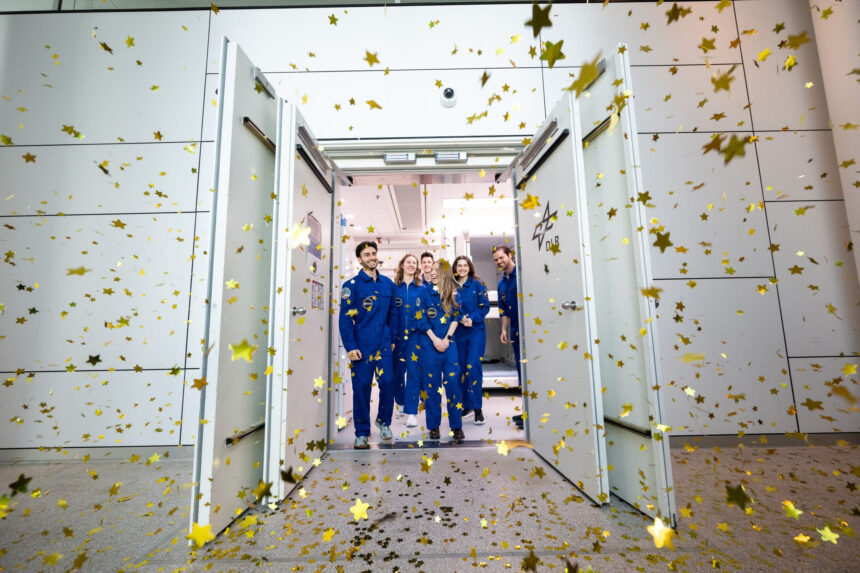
Six men and women from six countries on Friday ended a 100-day cramped, artificially lit isolation study in preparation for future space missions to the moon, Mars and beyond.
The participants in the SOLIS100 research study left the simulation facility of the German Aerospace Centre (DLR) in Cologne and returned to their daily lives after a final recovery phase.
The goal of the study, conducted on behalf of the European Space Agency (ESA), was to investigate the effects of long-duration missions – such as those to the moon or Mars – on health and performance under extreme conditions.
The participants from Germany, France, Italy, the Netherlands, Poland and Portugal spent more than three months cut off from the outside world in a confined environment without sunlight.
They had to make do with limited resources, such as non-perishable food, and without personal contact with family and friends.
Their daily routine consisted of scientific work, medical data collection, a strict exercise programme, and station maintenance. Contact with mission support took place primarily via an intercom system.
Outer space beckoning
According to DLR Division Director Anke Pagels-Kerp, such studies are essential for preparing astronauts for the mental and physical challenges of future missions to the moon or Mars.
The SOLIS100 study aims to standardize data to make future support measures for crews comparable, added project leader Amelie Therre.
The isolation took place at a research facility that enables world-leading studies on extreme environmental conditions. In total, the project lasted 126 days, including preparation and follow-up.
During the one-week follow-up phase after leaving the habitat on August 1, additional data on the crew’s physical and cognitive condition was collected.
The study team can now begin analysing the information collected over the entire period (before, during, and after isolation) to determine the developments and effects of isolation.
source :dpa