
Heirs Holdings chairman says Africa must leverage its resources, young entrepreneurs and capital to achieve sustainable economic prosperity.
Tony Elumelu, Chairman of Heirs Holdings, has called for a shift in the global approach to Africa’s development, urging greater emphasis on trade, investment and entrepreneurship rather than aid and dependency.
Reflecting on his engagements during the 81st Session of the United Nations General Assembly (UNGA81) in New York, Mr Elumelu said Africa possessed the resources, youthful population, energy potential and expanding consumer markets needed to drive its own economic transformation.
He argued that the continent must be recognised as a partner in global economic growth rather than a destination for charity and development assistance.
“Our continent has so much more to offer,” he stated, pointing to the growing capacity of African businesses to compete internationally and mobilise capital for large-scale investments.
African Capital for African Development
Mr Elumelu highlighted the role of African financial institutions in financing businesses and infrastructure, citing United Capital’s involvement in the Dangote Petroleum Refinery initial public offering (IPO) and the international operations of United Bank for Africa (UBA).
He also disclosed that discussions with Afreximbank President and Chairman, Dr George Elombi, focused on strengthening partnerships, financing transformational projects and expanding African capital markets to make long-term funding more accessible to businesses across the continent.
According to him, African financial institutions have a critical role to play in mobilising domestic resources to support industrialisation, enterprise development and job creation.
He maintained that stronger capital markets would enable African businesses to expand their operations, create value and compete more effectively in the global economy.
Reliable Energy Critical to Africa’s AI Future
Mr Elumelu also raised concerns about Africa’s ability to participate meaningfully in the global artificial intelligence (AI) economy without addressing its electricity challenges.
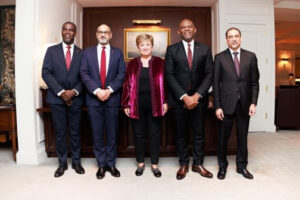
Following discussions with International Monetary Fund Managing Director Kristalina Georgieva, he emphasised that reliable electricity was essential not only for AI but also for manufacturing, digital infrastructure, healthcare, education and small businesses.
“AI needs electricity. Manufacturing needs electricity. Digital infrastructure, hospitals, schools and SMEs need electricity,” he stated.
He called for accelerated investment in energy infrastructure and the development of Africa’s gas resources to support industrialisation, identifying Transcorp Group and Heirs Energies as contributors to the continent’s energy development.
Mr Elumelu said reliable power supply had become a fundamental requirement for economic competitiveness, stressing that Africa’s digital ambitions must be supported by the infrastructure needed to realise them.
Youth Entrepreneurship as a Driver of Economic Growth
The Heirs Holdings chairman reaffirmed his commitment to youth empowerment, describing young people as Africa’s most valuable resource.
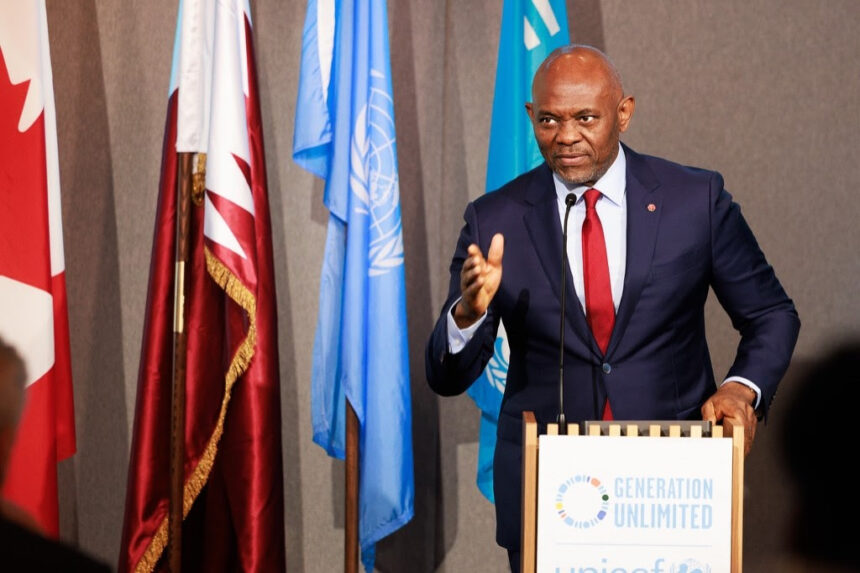
As a member of UNICEF Generation Unlimited’s Global Leadership Council, he participated in discussions on preparing young people for productive futures.
He also highlighted the work of the Tony Elumelu Foundation (TEF), which he established with his wife, Awele, to support African entrepreneurs through training, mentorship and seed funding.
Through the BeGreen initiative, the Foundation, Generation Unlimited and the IKEA Foundation are supporting young Africans to transition from learning to earning.
Mr Elumelu said investment in entrepreneurship could help unlock the potential of Africa’s youthful population by equipping young people with the skills, resources and opportunities required to build sustainable businesses.
‘Africa Needs Trade and Investment, Not Aid’
Speaking at the Darryl G. Behrman Lecture on Africa Policy, organised in connection with the Council on Foreign Relations and attended by its president, Ambassador Michael Froman, Mr Elumelu reiterated his position that Africa’s development must be driven by productive investment and enterprise.
He said industrialisation required reliable electricity, transportation networks, infrastructure, capital and policies that inspired investor confidence.
He called on the private sector to invest, innovate, operate efficiently and create jobs, describing this approach as Africapitalism — the philosophy that the private sector has both the capacity and responsibility to contribute to Africa’s economic and social development.
Mr Elumelu further argued that economic opportunity should be considered an essential component of security, warning that the absence of economic hope could contribute to instability, forced migration and vulnerability to extremism.
He cited the Tony Elumelu Foundation’s work with the United Nations Development Programme in fragile states as an example of how entrepreneurship could support economic recovery and social stability.
He added that philanthropy should empower people and businesses to become self-sufficient rather than create permanent dependency.
Tony Elumelu Foundation Reports More Than 1.5 Million Jobs
A major highlight of his UNGA engagements was the launch of the Tony Elumelu Foundation’s 15-year impact report, which documented the Foundation’s contribution to African entrepreneurship.
According to the report figures cited by Mr Elumelu, entrepreneurs supported by the Foundation have created more than 1.5 million direct and indirect jobs and generated over US$4.2 billion in revenue.
The report also indicated that 80 per cent of entrepreneurs funded since 2015 remained in business, while more than 25 per cent had attracted additional investment.
The Foundation has empowered more than 7,183 women, 85 per cent of whom lead their businesses.
Mr Elumelu said an independent assessment found that businesses supported with US$5,000 in seed capital created jobs at a cost of less than US$80 per job.
He said the results demonstrated the investment potential of African entrepreneurs and reinforced the importance of providing them with the resources needed to grow.
Partnerships Must Work With Africa
During his engagements, Mr Elumelu also participated in the Clinton Global Initiative Executive Roundtable on Economic Opportunity and Security in a New Era, alongside former United States President Bill Clinton and other global leaders.
He subsequently met World Bank Group President Ajay Banga, with discussions reinforcing the importance of partnerships that work with African countries rather than simply designing interventions on their behalf.
Mr Elumelu said Africa needed international cooperation but must approach such partnerships with greater confidence in its own resources, markets, entrepreneurial talent and capital.
“Africa needs the world, and the world needs Africa,” he said, emphasising the importance of mutually beneficial relationships that advance shared prosperity.
He also reflected on receiving recognition from the Appeal of Conscience Foundation at its 61st Annual Appeal of Conscience Awards Dinner, having been unable to attend the previous year following the tragic Afriland Towers fire, which claimed the lives of United Capital colleagues.

Turning Potential Into Prosperity
Mr Elumelu’s UNGA81 engagements centred on a common message: Africa’s development requires a stronger combination of domestic capital mobilisation, private-sector investment, energy security, youth entrepreneurship and international partnerships.
His Africapitalism philosophy places business and entrepreneurship at the centre of efforts to generate economic growth and social impact.
He maintained that Africa’s challenge was no longer simply to demonstrate its potential, but to translate that potential into sustained prosperity through investment, enterprise and partnerships that deliver measurable results.
He concluded that the work of transforming Africa must continue beyond international gatherings, with practical action at home to expand opportunities, strengthen businesses and create lasting economic value.