

Vice President Naana Jane Opoku-Agyemang has reaffirmed government’s commitment to deepening collaboration with traditional authorities as a critical pathway to sustaining peace, strengthening governance, and accelerating development across Ghana.
The Vice President made the remarks after joining John Dramani Mahama at the Presidency to receive a high-powered delegation from the Eastern Regional House of Chiefs, led by its President, Nene Sakite II. The delegation also included the Vice President of the House, Daasebre Akuamoah Agyapong II.
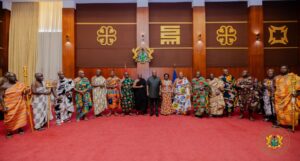
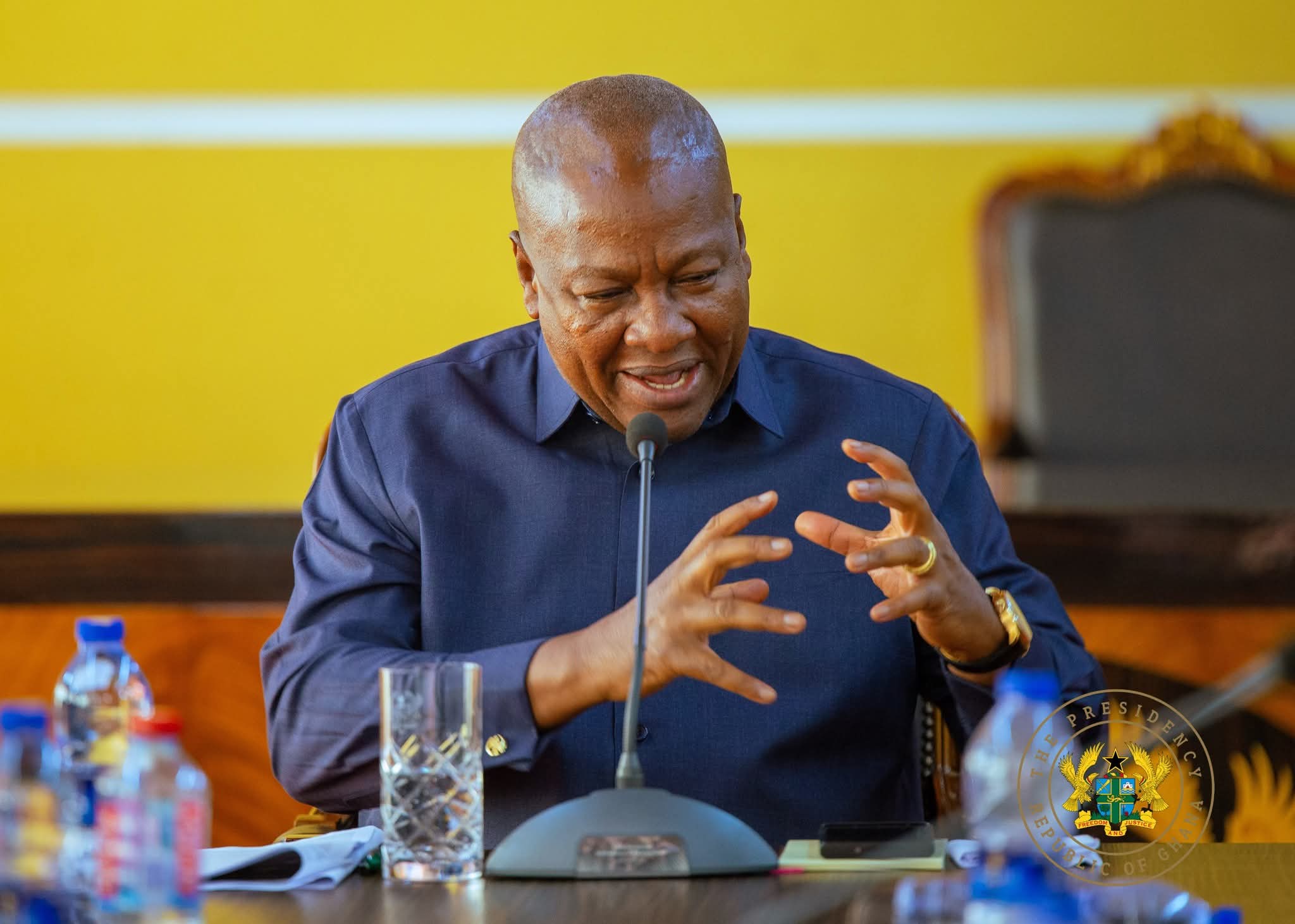
 President Mahama and Vice President Jane Naana Opoku-Agyemang.
Related Stories

The meeting brought together key government officials, including the Minister for Local Government, Chieftaincy and Religious Affairs, Ahmed Ibrahim, and the Eastern Regional Minister, Rita Akosua Adjei Awatey, underscoring the importance of state–traditional authority engagement in national development.
Chiefs Commend Government on Stability
Speaking on behalf of the delegation, Nene Sakite II expressed appreciation to government for its continued engagement with traditional institutions and its role in maintaining national peace.
“We are grateful for the respect and recognition accorded to traditional authorities,” he stated. “The peace and stability we are witnessing across the country are a result of deliberate collaboration, and we are committed to sustaining this partnership.”
The chiefs further acknowledged government’s responsiveness to development concerns in the Eastern Region and pledged their continued support for national initiatives.
Vice President Highlights Shared Responsibility
In her remarks, Vice President Opoku-Agyemang emphasized the indispensable role of chiefs in governance and community development.
“Traditional authorities remain central to Ghana’s democratic and social architecture,” she said. “Our progress as a nation depends on strong partnerships that connect policy to the lived realities of our communities.”
She stressed that peacebuilding, particularly in areas affected by chieftaincy disputes, requires sustained dialogue and mutual respect.
“We must continue to work together to resolve conflicts through dialogue and lawful processes,” the Vice President noted. “Peace is not accidental; it is built through cooperation, trust, and shared responsibility.”
President Outlines Development Agenda
President Mahama used the engagement to outline government’s ongoing efforts to stabilize the economy and create opportunities for citizens.
“We are focused on restoring macroeconomic stability, maintaining fiscal discipline, and investing in sectors that generate sustainable employment,” he said.
He highlighted key interventions under the government’s flagship “Big Push” infrastructure programme, as well as investments in healthcare and education.
“In healthcare, we are expanding access through initiatives such as the Ghana Medical Trust Fund and free primary healthcare, supported by mobile outreach services to underserved communities,” the President explained. “In education, we are scaling up investments to strengthen foundational learning and improve outcomes.”
Focus on Security and Development
Issues of peace and security, particularly chieftaincy-related conflicts, featured prominently in the discussions. Both government and the chiefs agreed on the need for continuous collaboration to prevent disputes and maintain stability.
Vice President Opoku-Agyemang underscored this point, stating:
“Security and development are intertwined. Without peace, development cannot be sustained, and without development, peace remains fragile.”
Renewed Commitment to Inclusive Growth
The meeting concluded with a renewed pledge by both parties to strengthen cooperation to ensure that development reaches all communities.
“We are committed to ensuring that no region is left behind,” the Vice President affirmed. “Our partnership with traditional leaders is key to delivering inclusive growth and improving the lives of our people.”
The engagement reflects government’s broader strategy of working closely with traditional institutions to promote peace, enhance local governance, and drive equitable national development.