
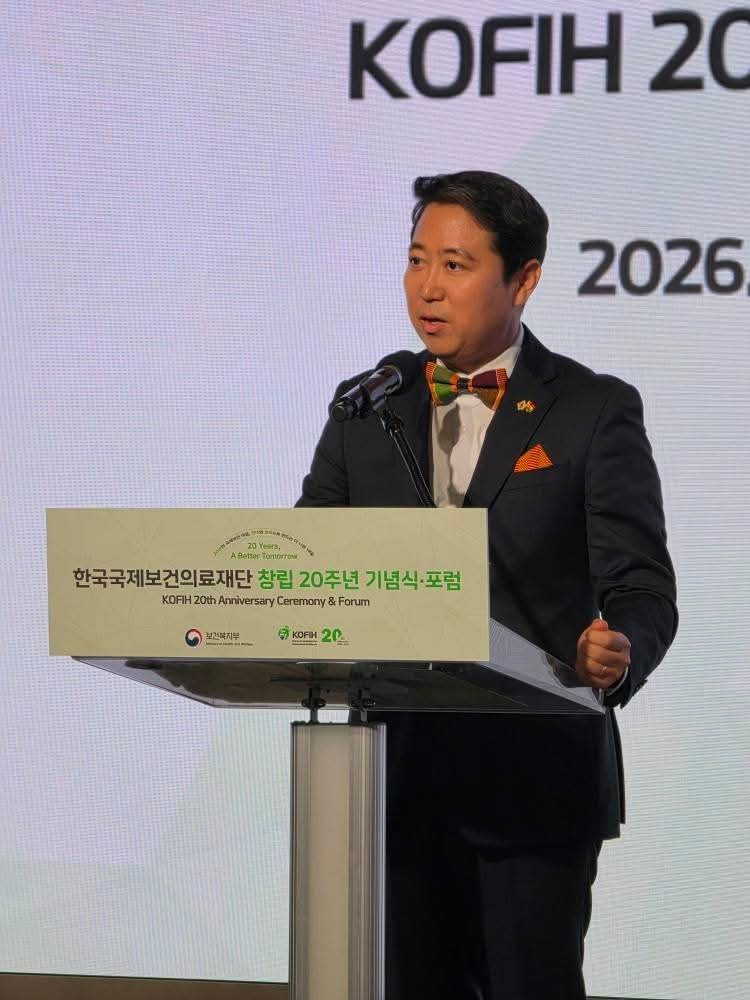
Ghana’s Ambassador to the Republic of Korea, Ambassador Kojo Choi has reaffirmed Ghana’s commitment to building a health partnership with Korea that goes beyond diplomatic dialogue to deliver concrete and measurable benefits for Ghanaians.
The Ambassador made the remarks at the 20th Anniversary Celebration and Forum of the Korea Foundation for International Healthcare (KOFIH) on August 13, where he delivered congratulatory remarks and highlighted the longstanding collaboration between Ghana and Korea in the health sector.
He described the occasion as more than a ceremonial celebration, saying it provided an opportunity to reflect on how bilateral cooperation could be translated into practical interventions that respond directly to Ghana’s development priorities.
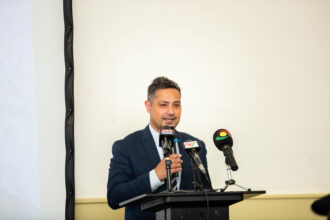
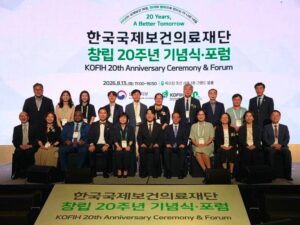 Ambassador Kojo Choi at 20th Anniversary Celebration and Forum of the Korea Foundation For International HealthCare(KOFIH)
KOFIH’s contribution to Ghana’s health sector
Over the years, KOFIH has supported Ghana in several critical areas, including maternal and child health, healthcare capacity development, advanced surgical services, medical equipment management, biomedical engineering, emergency care and rehabilitation services.
One notable intervention has been support for the establishment of a Biomedical Engineering Workshop at the Greater Accra Regional Hospital. The initiative has contributed to building local expertise to maintain and manage essential medical equipment, helping to reduce dependence on external technical support.
KOFIH has also supported the expansion of laparoscopic surgery capacity in Ghana, providing Ghanaian healthcare professionals with advanced knowledge and skills while contributing to the expansion of modern surgical services in public hospitals.
From an Ambassadorial conversation to a new ODA project
Ambassador Kojo Choi said the partnership had entered another significant phase following the 2026 Ambassadors’ Roundtable, where Ghana’s healthcare priorities were presented.
At the engagement, he specifically encouraged KOFIH to consider supporting the digital transformation of Ghana’s National Health Insurance Scheme (NHIS).
According to the Ambassador, that proposal has since progressed into a new Official Development Assistance (ODA) project, demonstrating the potential of strategic diplomacy to translate identified national priorities into tangible development programmes.
“We identify Ghana’s priorities. We connect them with Korea’s expertise and institutions. We make the case. We follow through. And, most importantly, we deliver.”
The proposed digitalisation of the NHIS could have significant implications for the efficiency of health financing and administration, while potentially improving access to healthcare services for Ghanaians.
Diplomacy that delivers
The Ambassador said his role should not be limited to representing Ghana diplomatically, but should also involve building bridges between Ghanaian priorities and Korean institutions, expertise, technology and investment opportunities.
He described the KOFIH partnership as an example of what can happen when Ghana clearly articulates its development needs and those priorities are matched with Korea’s technological capabilities and institutional experience.
The approach, he suggested, represents a shift from diplomacy centred primarily on discussions and agreements towards “diplomacy that delivers.”
The Kofi connection
The anniversary celebration also provided an opportunity to reflect on the historic connections between Ghana and Korea.
The Ambassador noted the significance of the name KOFIH, joking that as a Ghanaian named Kojo, he initially thought it sounded like a particularly Ghanaian name because “Kofi” is one of the country’s most familiar names.
Beyond the humour, however, he said the repeated presence of images of Kofi Annan, the late Ghanaian UN Secretary-General, and Dr. Lee Jong-wook, the former Director-General of the World Health Organization and a prominent Korean global-health leader, offered a powerful reminder of the contributions of both countries to the international community.
Kofi Annan demonstrated the impact Ghanaian leadership could have on global affairs, while Dr. Lee Jong-wook represented Korea’s commitment to advancing global health.
The Ambassador said the two countries now have an opportunity to build on that legacy.
A partnership focused on results
Ghana–Korea relations have expanded considerably beyond traditional diplomatic engagement, encompassing health, education, technology, infrastructure, skills development and economic cooperation.
The Ambassador said his commitment is to continue connecting Ghana with appropriate Korean institutions, opening doors for collaboration and ensuring that promising conversations develop into projects with measurable outcomes.
The KOFIH partnership, he maintained, demonstrates the possibilities when diplomacy is linked directly to national development priorities.
“Not only through promises, but through projects that make a difference in the lives of Ghanaians,” he said.
The emerging NHIS digitalisation project could therefore become an important test of the “From Dialogue to Delivery” approach—demonstrating how diplomatic engagement can translate into practical solutions for Ghana’s healthcare system.
Ghana and Korea: together, turning partnerships into results.