

By Rebecca Ekpe | Editor-in-Chief, Ghana Broadcasting Corporation (GBC) | Vice President, Ghana Journalists Association (GJA)
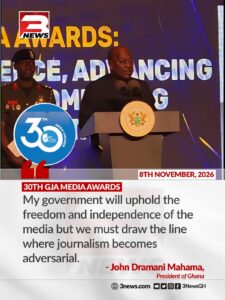
President John Dramani Mahama’s recent comments on adversarial journalism at the 30th Ghana Journalists Association (GJA) Media Awards have reopened an important conversation about the role, responsibility and professional conduct of journalists in Ghana’s democracy.
Speaking at the awards ceremony on November 7, 2026, the President cautioned journalists against what he described as an unnecessary pursuit of scandals, particularly where media practitioners deliberately seek confrontation with public officials over alleged discrepancies.
Related Stories

He questioned the practice of journalists publicly challenging ministers to appear on their programmes to defend themselves against issues raised on air, describing such conduct as potentially crossing the boundaries of responsible journalism. He, however, reaffirmed his government’s commitment to protecting the media’s watchdog responsibility.
His comments raise a fundamental question that every journalist, editor, broadcaster and media organisation must be prepared to confront:
When does holding power accountable become an exercise in adversarial journalism?
It is a question worth discussing, particularly at a time when Ghana’s media landscape is increasingly polarised, political conversations are becoming more combative, and the competition for audience attention sometimes rewards sensationalism over substance.
But let us be clear: journalism is not supposed to be comfortable for those in power.
The responsibility of the media is to ask difficult questions, investigate public expenditure, interrogate government policies, expose wrongdoing and give citizens the information they need to make informed decisions.
When public funds are involved, journalists must ask questions. When promises are made, they must follow up. When inconsistencies emerge, they must investigate. When public officials fail in their responsibilities, the media must demand answers.
That is not adversarial journalism. That is accountability.
However, there is a difference between being firm and being hostile; between being persistent and being provocative; between pursuing the truth and pursuing a confrontation.
Accountability journalism begins with a question. Adversarial journalism, in its negative form, begins with a conclusion.
The distinction is important.
An accountable journalist approaches a story with an open mind, examines the available evidence, seeks different perspectives and gives those involved a fair opportunity to respond.
An adversarial journalist may approach the same story with a predetermined position, looking for an opportunity to embarrass, discredit or defeat the person being questioned.
One is driven by the public interest. The other risks being driven by personal, political or institutional interests.
The danger of turning journalism into a political battlefield
Ghana has experienced periods when sections of the media have appeared more interested in defending political parties than interrogating their actions.
During election seasons, this becomes even more pronounced.
Some journalists become so identified with particular political interests that their reporting loses the independence, balance and credibility that should define the profession.
Radio and television discussions sometimes resemble political contests, with presenters and panellists more interested in scoring points than examining evidence.
Headlines become weapons. Interviews become confrontations. Political affiliations begin to influence editorial judgement.
This is dangerous for democracy.
We do not need journalists who fight for political parties. We need journalists who fight for facts.
The media must be equally uncomfortable with wrongdoing, whether it happens under the government of the day or the opposition. The journalist’s loyalty must be to the truth and the Ghanaian public, not to political convenience.
But accountability must never be mistaken for hostility
While President Mahama’s comments deserve serious consideration, they must also invite an equally important reflection: Who determines when journalism has crossed the line into adversarial conduct?
There must be no situation in which the discomfort of a public official becomes the measure of irresponsible journalism.
A minister being challenged on national television does not automatically mean the journalist is being adversarial. A president being asked to explain an unpopular policy does not amount to disrespect. An investigation that exposes inconsistencies in public expenditure cannot be dismissed simply because the findings are inconvenient.
Indeed, the media’s constitutional mandate is not dependent on whether those in authority appreciate the questions being asked.
Article 162 of Ghana’s 1992 Constitution guarantees freedom and independence of the media and protects journalists from censorship or interference in their work.
That independence comes with responsibility, but it must also come with protection.
The media must be allowed to scrutinise government without intimidation, just as journalists must be prepared to subject their own work to professional and ethical scrutiny.
The test should not be whether a journalist has embarrassed a minister or government official. The test should be whether the journalist has acted professionally, verified the facts, provided context and served the public interest.
The responsibility of journalists and editors
As journalists, we must also look inward.
The pressure to break news, attract attention and generate audience engagement must never become an excuse for abandoning professional standards.
A journalist should not manufacture controversy where none exists. Allegations must be investigated. Figures must be verified. Sources must be assessed. Those accused must be given a fair opportunity to respond.
Equally, journalists must resist the temptation to turn interviews into personal battles.
Being aggressive does not necessarily make one a good journalist. Being loud does not make a question more intelligent. And humiliating an interviewee is not proof of professional excellence.
The strength of journalism lies in the quality of its questions, the credibility of its evidence and the courage to pursue the truth, even when the truth is inconvenient.
Editors also have a responsibility to ensure that editorial independence is not confused with editorial recklessness.
At the Ghana Broadcasting Corporation, the principles of public service broadcasting remind us that journalism must inform, educate and hold power accountable while promoting fairness, accuracy, balance and responsible public discourse.
What Ghana needs now
President Mahama’s intervention should not be the beginning of a debate about whether journalists should be tougher or softer on government.
It should be an opportunity to strengthen the quality of journalism in Ghana.
We need a media profession that is courageous without being combative, independent without being partisan, critical without being malicious and responsible without becoming timid.
Government must understand that scrutiny is not hostility. Journalists must understand that independence is not a licence for recklessness.
Both sides have a responsibility to protect the democratic space.
Ultimately, journalism must never become a public relations extension of government, an opposition propaganda machine or a platform for settling personal scores.
It must remain a credible institution that speaks truth to power, gives voice to the voiceless and places the public interest above every other consideration.
My position is simple: Journalism should be accountable, not adversarial.
Accountable means I will ask you difficult questions, whoever you are.
Adversarial means I have already decided you are the enemy.
Let us be firm with everyone and fair to everyone. Let us question power without fear, report without favour and investigate without prejudice.
Ghana does not need journalists who fight for parties.
Ghana needs journalists who fight for facts.
That is the journalism our democracy deserves. That is the journalism our profession must defend.
— Rebecca Ekpe
Editor-in-Chief, Ghana Broadcasting Corporation (GBC)
Vice President, Ghana Journalists Association (GJA)