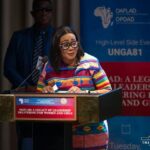

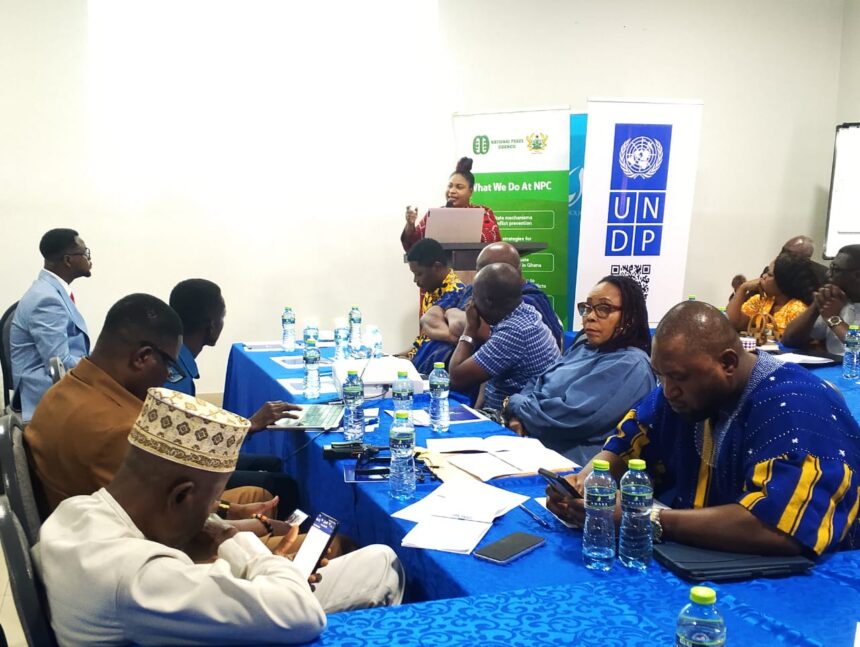
Vice President of the Ghana Journalists Association (GJA), Rebecca Ekpe, has called on media practitioners to uphold the highest standards of professional ethics and responsible journalism to promote political tolerance, social cohesion and peace in Ghana.
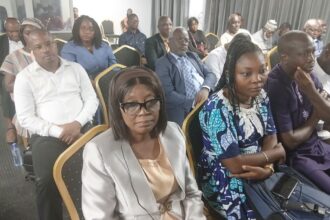
Speaking at an Inter-Party Dialogue in Accra, Ekpe said the media remains one of the most influential institutions in shaping public opinion and political discourse, particularly in an increasingly polarised information environment.

She said while journalists have a responsibility to scrutinise political actors and expose wrongdoing, the manner in which political disagreements are reported can either strengthen democratic dialogue or deepen divisions.
“The question is not whether the media should report political disagreements—we must. The question is how we report those disagreements without deepening tensions or creating unnecessary divisions in society,” she said.
According to her, Ghana’s democratic development requires a media that is independent and critical while remaining committed to accuracy, fairness, professionalism and the national interest.
“We need a media that is firm but fair, critical but responsible, and independent while conscious of the potential impact of its work on national stability,” Ekpe stated.
Avoid inflammatory reporting
Ekpe urged journalists and editors to pay particular attention to the language used in headlines, news introductions, political commentary and social media posts.
She cautioned that sensational headlines and provocative descriptions can sometimes transform ordinary political disagreements into seemingly irreconcilable confrontations.
“A disagreement over policy should not automatically be presented as a war between political enemies. Our language matters because the words we use can either calm a situation or inflame it,” she said.
She encouraged editors to review headlines and social media captions carefully, particularly when dealing with politically sensitive issues.
For instance, she said, a headline describing political actors as having “launched a fresh attack” could unnecessarily heighten tensions when the actual issue may simply be a disagreement over policy.
Fairness must remain central
The GJA Vice President also stressed the importance of giving political parties and individuals affected by allegations a fair opportunity to respond.
She said journalists must distinguish between reporting an allegation and presenting an allegation as established fact.
“Report the allegation, but do not report the allegation as though it is already proven. Tell your audience who is making the claim, seek a response from the affected party and make the distinction clear,” she advised.
She urged journalists to use appropriate attribution, including phrases such as “the minister alleges,” “according to the opposition,” or “the government has denied the claim.”
Such practices, she noted, protect the credibility of the journalist and media organisation while allowing audiences to make informed judgments.
Political talk shows need stronger moderation
Ekpe expressed concern about the increasing tendency for some political talk shows to degenerate into personal attacks, insults and unsubstantiated allegations.
She said presenters have a professional responsibility to moderate discussions and challenge panellists when they make serious claims without evidence.
“A political talk show should not become a marketplace for insults, personal attacks and allegations without evidence. The presenter must be prepared to ask the simple but important question: ‘Can you provide evidence to support that claim?’” she said.
She said where a panellist makes a serious allegation against another person or institution, the presenter should insist on evidence or ensure that the allegation is appropriately qualified.
“We must move the conversation from personalities to issues. If someone says another person is a criminal or has stolen public money, that is a serious allegation. It should not simply be thrown into the public space without challenge,” Ekpe added.
Verification critical in the digital age
The Vice President identified misinformation and disinformation as major threats to responsible political communication, especially during elections.
She said the speed with which information travels through social media places an even greater responsibility on journalists to verify material before broadcasting or publishing it.
“The fact that something is trending does not make it news, and the fact that thousands of people have shared a video does not make the video authentic,” she cautioned.
She urged journalists to establish the origin, date, location and authenticity of photographs, videos and audio recordings before using them.
“Before you broadcast that video, ask: When was it recorded? Where was it recorded? Who recorded it? Can we independently verify it? If we cannot establish the facts, we should not present it to the public as truth,” she said.
She noted that old photographs and videos are sometimes recycled during elections and presented as evidence of current incidents, potentially creating fear and tension.
Do not amplify hate speech
Ekpe further urged media practitioners to distinguish between reporting inflammatory speech and amplifying inflammatory speech.
She said political statements capable of provoking hostility should be reported with context and restraint rather than repeatedly broadcast simply because they generate audience attention.
“Our responsibility is to inform the public, not to amplify provocation. Sometimes the most sensational soundbite is not necessarily the most responsible piece of journalism,” she said.
She encouraged journalists to provide context when reporting inflammatory statements and to avoid unnecessarily repeating provocative language.
Promote issue-based journalism
According to Ekpe, one of the most effective ways the media can contribute to political tolerance is by shifting political coverage from personalities and partisan confrontation towards policies and evidence.
She encouraged journalists to ask politicians difficult but constructive questions about the feasibility, cost and potential impact of their policies.
“Instead of simply asking who is right or wrong, we should ask: What is the evidence? What will this policy cost? Who will benefit? Who will bear the cost? How will it be implemented?” she said.
She said such an approach would help voters make decisions based on information rather than emotion and partisan loyalty.
Conflict-sensitive journalism
Ekpe also advocated greater adoption of conflict-sensitive journalism, particularly when covering elections, protests, political disputes and other potentially volatile situations.
She explained that conflict-sensitive reporting does not require journalists to suppress difficult stories or shield political actors from scrutiny.
“Peace journalism does not mean avoiding difficult stories. It means reporting difficult stories responsibly, accurately and with an understanding of their potential consequences,” she said.
She encouraged newsrooms to provide audiences with a broader picture of political disputes by reporting not only disagreements but also mediation efforts, calls for calm, institutional responses and initiatives aimed at resolving conflicts.
Greater responsibility during elections
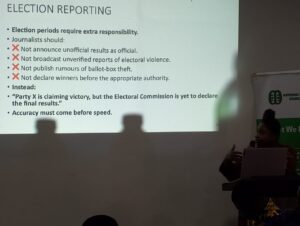
Ekpe said the media’s responsibility becomes even more critical during elections because inaccurate reporting can rapidly generate tension and undermine public confidence in democratic institutions.
She cautioned journalists against declaring election results before the appropriate electoral authorities have done so.
“The media must never confuse a party’s claim of victory with an officially declared result. If a political party claims victory, report that it has claimed victory. Do not present the claim as the final result when the Electoral Commission has not made the declaration,” she stressed.
She also urged journalists to exercise extreme caution when reporting alleged incidents of electoral violence, ballot-box theft, deaths or electoral fraud.
“An unverified report of violence can itself become a source of violence. We therefore have to verify before we broadcast,” she said.
A newsroom culture of verification
The GJA Vice President called on media organisations to strengthen internal editorial systems for politically sensitive stories.
She proposed a simple newsroom test based on five principles:
SOURCE — VERIFY — BALANCE — CONTEXT — IMPACT.
Journalists, she said, should establish the source of information, independently verify it where possible, seek responses from affected parties, provide sufficient context and consider whether the presentation could unnecessarily escalate tensions.
“Before we press the publish or broadcast button, we should ask ourselves five questions: Where did this information come from? Have we verified it? Have we heard the other side? Have we provided the necessary context? And could our presentation unnecessarily inflame the situation?” she said.
Journalists as democratic actors
Ekpe said journalists should recognise that they play an important role in creating the information environment within which democratic participation takes place.
She said the media should not become an extension of political parties or allow partisan interests to compromise professional judgment.
“Journalists are not political party spokespersons. Our duty is to the public. We must scrutinise power, hold political actors accountable and give citizens the information they need to participate meaningfully in democracy,” she said.
She added that political tolerance does not require journalists to avoid criticism or difficult questions.
“Tolerance does not mean silence. Accountability does not mean hostility. Independence does not mean irresponsibility,” Ekpe stated.
Creating space for democratic disagreement
She said Ghana’s democracy would benefit from a media environment where political actors can disagree strongly without being portrayed as enemies and where citizens can engage in political debate without being encouraged to hate one another.
“Democracy is built on disagreement. We cannot and should not eliminate disagreement. What we must do is create a public space where disagreement can exist without becoming hostility,” she said.
Ekpe urged media practitioners to see themselves not merely as reporters of political events but as professionals whose work can contribute to strengthening democratic institutions and social cohesion.
“Our responsibility as journalists is not to manufacture consensus, but to create an informed public space where disagreement can exist without becoming hostility, and where political competition does not destroy social cohesion,” she said.
She concluded by calling for stronger collaboration among journalists, media houses, political parties, civil society organisations and other stakeholders to promote responsible political communication.
“The peace of Ghana cannot be left to chance. Every institution has a role to play, and the media have a particularly important role because of its ability to shape what citizens see, hear and believe,” Ekpe said.
Her message was clear: political tolerance requires responsible political communication, and responsible political communication begins with ethical journalism.