
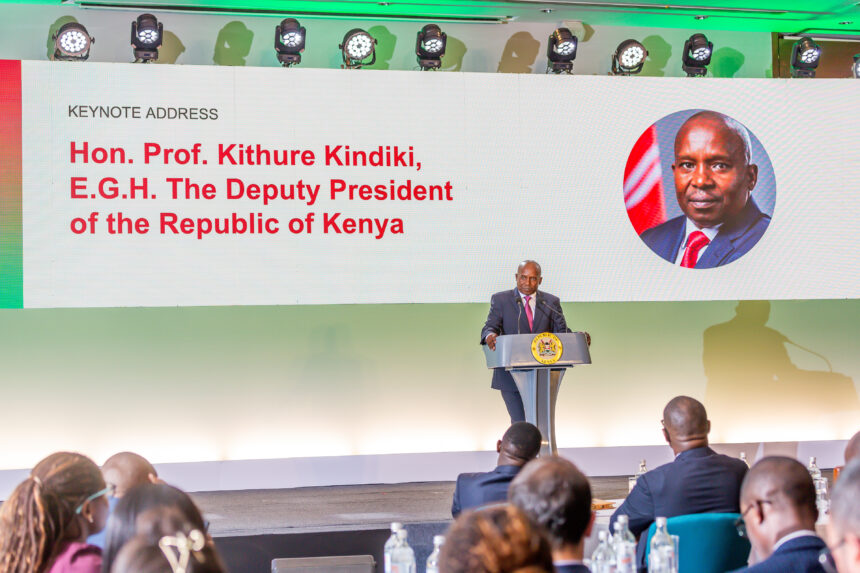
Kenya has set out an ambitious vision to position itself at the centre of Africa’s financial and technological transformation, with Deputy President Kithure Kindiki declaring that shifting global dynamics present a unique opportunity for the continent to attract increased private investment.
Delivering a keynote address at the AVCA Annual Conference & VC Summit, Prof. Kindiki underscored Africa’s growing relevance as a frontier market amid geopolitical uncertainty, urging investors to look to the continent for diversification and long-term growth.
“Geopolitical uncertainty positions Africa as an increasingly recognised frontier for growth and diversification,” he stated, adding that Kenya, and particularly Nairobi, is emerging as a key hub for financial innovation and technology-driven investment.
Private Capital Driving Transformation
The Deputy President emphasised the critical role of private equity and venture capital in advancing structural transformation across Africa.
“Private equity and venture capital are critical drivers of structural transformation,” he said. “They accelerate industrialisation and support sustained long-term productivity growth.”
He commended African Private Capital Association for its 25-year contribution to developing the continent’s investment landscape.
“Your role in educating, connecting, and convening global allocators has been instrumental in shaping and expanding Africa’s private capital ecosystem,” Prof. Kindiki noted.
Strong Investment Performance Signals Confidence
Kenya’s investment climate, he said, is already demonstrating strong momentum. The country attracted nearly $984 million in startup funding in 2025, accounting for approximately 32 percent of Africa’s total, while private equity penetration remains among the highest in the region.
“Kenya records one of the highest penetration rates in the Middle East and Africa, with over 13 percent of companies being private equity-backed—well above regional averages,” he revealed.
Across East Africa, the investment ecosystem has also shown signs of recovery.
“Over $865 million was deployed across more than a hundred deals in 2025, reflecting a clear rebound in both deal size and investor conviction,” he added.
Untapped Domestic Capital Potential
Despite these gains, Prof. Kindiki highlighted significant opportunities to deepen domestic participation in private capital markets.
“Kenya’s fund managers oversee more than KES 2.5 trillion in assets, alongside pension assets exceeding $13 billion,” he said. “Yet less than one percent is currently allocated to private equity—highlighting significant headroom for scale.”
He stressed that unlocking this capital will be essential to reducing reliance on public debt and financing sustainable development.
“We are actively rethinking how we finance development—moving beyond traditional reliance on public debt toward the mobilisation of private capital,” he stated.
Public-Private Partnerships at the Core
The Deputy President outlined an action plan anchored on public-private partnerships (PPPs) to attract global investment into key sectors.
These include large-scale infrastructure development to modernise roads, railways, airports, and ports without increasing public debt, as well as an ambitious energy transition agenda aimed at achieving 100 percent green energy generation and tripling production capacity.
In agriculture, the government plans to accelerate transformation through irrigation and value addition, targeting an additional 2.5 million acres under irrigation.
New Financing Vehicles and Regulatory Reforms
To support these priorities, the government is introducing innovative financing mechanisms, including a National Infrastructure Fund and a sovereign wealth fund designed to enhance project delivery and protect the economy from external shocks.
Prof. Kindiki also highlighted the strategic role of the Nairobi International Financial Centre, describing it as “not merely a facilitator of investment, but an active architect of the ecosystem.”
He assured investors of continued efforts to strengthen regulatory frameworks and maintain macroeconomic and political stability.
“Kenya is positioning itself as a predictable and competitive destination for capital deployment and strategic decision-making,” he said.
Call for Continental Collaboration
As Kenya advances its economic transformation agenda, the Deputy President called on other African nations to collaborate in building a stronger, more resilient continent.
“Kenya stands on the cusp of a financial and technological renaissance,” he declared. “We urge the rest of the continent to join us in nation-building and shaping a shared future of prosperity.”
The address reinforced Kenya’s ambition to lead Africa’s next phase of growth by leveraging private capital, strengthening institutions, and fostering innovation in an increasingly volatile global environment.