
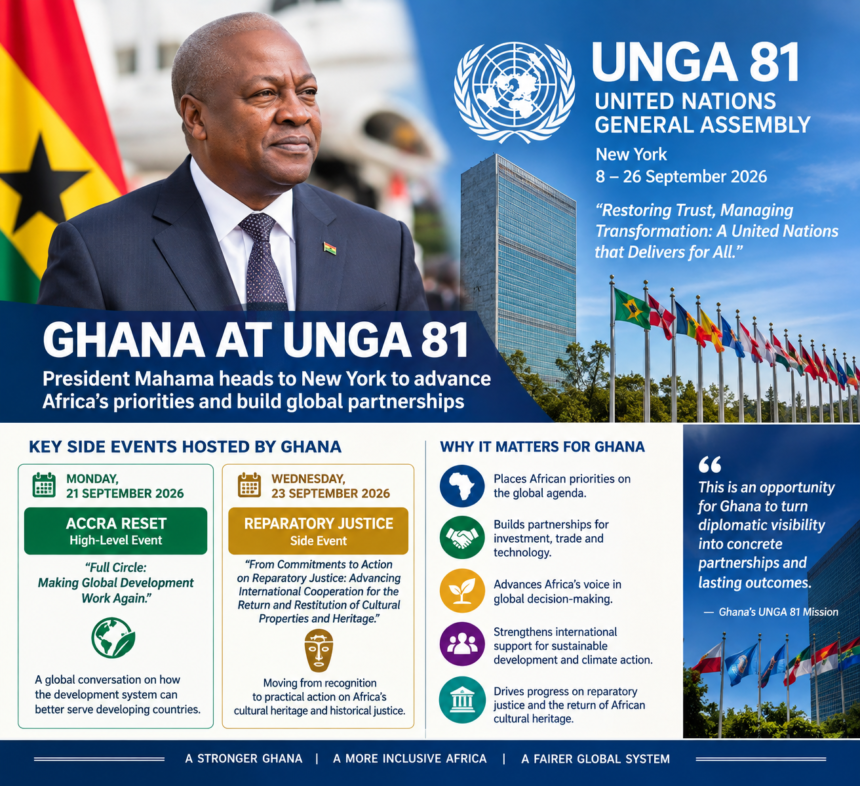
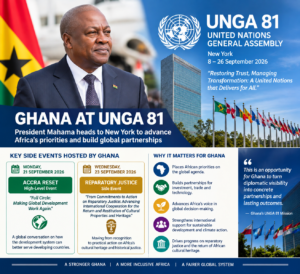
President John Dramani Mahama’s participation in the 81st United Nations General Assembly (UNGA 81) in New York comes at a significant moment for global cooperation. The Assembly, which opened on 8 September 2026, is being held under the theme “Restoring Trust, Managing Transformation: A United Nations that Delivers for All.” The theme speaks directly to some of the most pressing challenges confronting the international system: declining confidence in multilateral institutions, inequality in global decision-making, conflicts, climate change, development financing and the need to ensure that technological and economic transformation benefits all countries.
For Ghana, therefore, the New York engagement is more than participation in another international diplomatic gathering. It provides a platform to project Ghanaian and African priorities onto the global agenda and to seek movement from international commitments to measurable action.
Ghana’s opportunity to influence the global development conversation
One of the most important aspects of President Mahama’s programme is the Accra Reset. On Monday, 21 September, he will host a high-level event titled “Full Circle: Making Global Development Work Again.” The discussion is expected to examine how the international development system can become more responsive to the realities and priorities of developing countries.
Related Stories

The Accra Reset has evolved from an initial focus on health sovereignty into a broader conversation about the structural conditions that determine whether African countries can achieve sustainable development. Its proponents point to issues including debt, trade, intellectual property, migration, data governance and Africa’s negotiating power in the international system.
This gives Ghana an opportunity to make a fundamental argument: Africa should not only be a recipient of development policies designed elsewhere; African countries should have a stronger voice in determining the rules, financing arrangements and priorities that shape their development.
That message is particularly relevant as the UN seeks to revitalise multilateral cooperation and accelerate progress towards the Sustainable Development Goals.
Reparatory justice: moving from recognition to action
The second major Ghana-led engagement is equally significant.
On 23 September, President Mahama will host a high-level side event on “From Commitments to Action on Reparatory Justice: Advancing International Cooperation for the Return and Restitution of Cultural Properties and Heritage.” Ghana’s Foreign Ministry says the event will receive progress reports from the High-Level Advisory Council on Reparatory Justice, Global Experts Panel on the Restitution of Cultural Heritage and Global Legal Panel on Reparatory Justice established following the June 2026 Next Steps Conference in Accra.
This is important because the reparatory-justice conversation is increasingly moving beyond historical acknowledgement towards questions of what practical action should follow.
For Ghana, this could include sustained international cooperation around:
- the return and restitution of African cultural objects;
- preservation and documentation of African heritage;
- research into historical injustices;
- legal and institutional mechanisms for restitution;
- educational and cultural initiatives;
- and broader discussions about reparatory measures for Africans and people of African descent.
The New York meeting therefore gives Ghana an opportunity to keep reparatory justice within the mainstream of international diplomacy rather than treating it only as a historical or cultural issue.
A voice for Africa
President Mahama’s UNGA engagement also has a broader African dimension. Recent interventions by the President at the African Union have emphasised African ownership of the continent’s peace and security agenda and its financing, including the need for predictable and sustainable resources for African-led peace initiatives.
This connects with the wider question of how Africa participates in global governance.
Ghana can use its diplomatic presence in New York to reinforce conversations around Africa’s representation in international institutions, sustainable financing, peace and security, climate finance, development, trade and technology.
The significance is that Ghana’s voice can be used not simply to articulate national interests, but to demonstrate how some Ghanaian priorities intersect with wider African concerns.
Economic diplomacy: converting visibility into opportunities
Another important dimension of the New York visit is economic diplomacy.
According to the Presidency’s programme, President Mahama is scheduled to engage world leaders, the UN Secretary-General and multinational executives. He will also participate in a US-Ghana Presidential Roundtable, ring the NASDAQ Closing Bell, and engage with business leaders.
These engagements provide an opportunity to present Ghana not only as a participant in international diplomacy but as a country seeking investment, trade, technology partnerships and economic opportunities.
The real measure of this aspect of the visit, however, will be what follows after the photographs and meetings: whether engagements translate into investment commitments, partnerships, market opportunities, technology transfer, job creation and expanded opportunities for Ghanaian businesses.
What should Ghana hope to bring home from New York?
The most meaningful outcome would be to see the New York engagements produce concrete follow-up mechanisms.
Ghana could seek:
1. Stronger international support for the Accra Reset
Not simply endorsements, but participating governments and institutions willing to support specific reforms and initiatives.
2. Concrete progress on reparatory justice
Particularly mechanisms for restitution of cultural property, heritage preservation and continued international cooperation.
3. Greater investment and trade opportunities
The President’s meetings with investors and business leaders should ideally lead to identifiable opportunities for Ghanaian enterprises and sectors.
4. Stronger partnerships for development financing
Ghana can use the UN platform to advocate for development financing arrangements that better reflect the needs of developing economies.
5. Greater African influence in global decision-making
The broader objective should be to strengthen Africa’s voice in institutions and decisions that directly affect the continent’s future.
6. Practical partnerships on technology and innovation
Artificial intelligence, digital infrastructure, data governance and skills development are increasingly central to economic competitiveness.
The real test is what happens after New York
President Mahama’s departure for UNGA 81 places Ghana in an important diplomatic space at a time when the United Nations itself is calling for renewed trust and more effective multilateral cooperation.
The significance of Ghana’s presence will ultimately not be measured only by the prominence of its President’s speeches or the number of bilateral meetings held in New York. It will be measured by whether Ghana can turn diplomatic visibility into sustained partnerships, policy commitments and practical outcomes.
The two Ghana-led side events are particularly important because they position the country around two connected questions: How can the global development system work better for developing countries? And how can historical injustices be followed by meaningful action?
If Ghana can help move both conversations from declarations to implementation, the country’s UNGA 81 engagement could contribute not only to its national interests but also to a wider African effort to reshape the terms of global cooperation.
New York, therefore, is not simply a destination for Ghana’s President. It is a diplomatic opportunity for Ghana to make the case for a more responsive global system—and to demonstrate that African countries are prepared to move from being subjects of global decisions to active participants in shaping them.