

Young leaders from Africa and Japan have taken a decisive step towards shaping their own future with the launch of the Africa Japan Youth Alliance (AJYA), a new youth-owned platform designed to translate the aspirations of young people into concrete action.
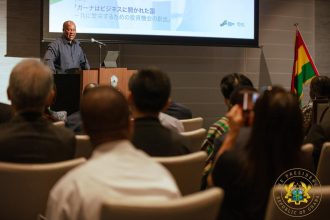
The alliance was launched during the TICAD Youth Drive 2026, held from 13–14 August 2026 at the Mensvic Grand Hotel in Accra, under the theme “Youth Agenda 2055: From Vision to Action.”


The two-day gathering brought together about 300 young leaders, entrepreneurs, innovators and changemakers from Africa and Japan, alongside representatives of governments, diplomatic missions, international organisations, civil society and development partners.
Convened by the Africa Diaspora Network Japan (ADNJ), the Africa Asia Youth Nest (AAYN), the Government of Ghana through the Ministry of Youth Development and Empowerment, and other Africa–Japan development partners, the Drive deliberately created space for young people from rural and underserved communities to participate in shaping the continent’s development agenda.
From consultation to action
The TICAD Youth Drive builds on a process that began with listening to young Africans and Japanese about the future they want.
At previous youth engagements, participants articulated their aspirations around opportunity, dignity, inclusion, innovation, employment and meaningful participation in decision-making.
Those ideas were subsequently developed into a policy framework.
The process culminated at Youth TICAD 2025, held alongside TICAD9 in Yokohama, Japan, where young people adopted “Youth Agenda 2055: The Future We Want” — a youth-authored framework outlining a shared Africa–Japan vision extending to 2055.
The Accra meeting therefore represented the next stage: moving from vision and policy to implementation.
Young people refuse to wait to be invited
A central message emerging from the Drive was that young people should no longer remain passive recipients of development programmes designed by others.
Instead, they should be co-creators, implementers, innovators and owners of the solutions affecting their future.
The organisers emphasised that the AJYA is intended to provide young Africans and Japanese with a standing platform through which they can collectively advance Youth Agenda 2055 and other continental and bilateral youth-development frameworks.
The alliance is designed to be youth-owned and youth-driven, providing a structure for sustained collaboration beyond conferences and high-level policy meetings.
Building capacity for implementation
Capacity development was a major component of the TICAD Youth Drive.
Participants engaged in facilitated skills sessions, applied case studies, peer-to-peer co-creation, innovation sessions and partnership laboratories, aimed at equipping young leaders with practical tools to transform ideas into implementable initiatives.
The Drive also provided young people with opportunities to demonstrate their existing skills, innovations and evidence-based projects before government officials, diplomatic representatives, investors and development stakeholders.
This approach sought to shift the conversation from what young people need to what young people can build and contribute.
Accra Declaration to drive policy
The two-day engagement culminated in the Youth TICAD Accra Declaration, which is expected to feed into policy, diplomatic and advocacy processes.
The Declaration, together with the launch of the AJYA, is intended to create the foundation for political, financial, technical and knowledge partnerships capable of scaling youth-led initiatives across Africa and Japan.
The organisers say the ultimate objective is not simply to produce another declaration, but to establish mechanisms through which young people can continue to implement, monitor and advocate for the commitments contained in Youth Agenda 2055.
A new chapter in Africa–Japan relations
The emergence of the Africa Japan Youth Alliance adds a youth-led dimension to the broader Africa–Japan partnership.
It signals a growing recognition that Africa’s young population is not merely a demographic statistic but a major force for economic transformation, technological innovation, entrepreneurship, social development and democratic participation.
For Japan, the partnership also creates opportunities for deeper engagement with Africa’s emerging generation of innovators and entrepreneurs.
For Africa, it provides a platform to strengthen connections with Japanese institutions, businesses, investors, researchers and young professionals.
The TICAD Youth Drive 2026 has therefore positioned Accra not simply as the venue for another youth conference, but as the launchpad for a new generation of Africa–Japan youth cooperation.
The future they want
At the heart of the initiative is a simple proposition: young people should have a direct role in building the future they have already imagined.
From the vision articulated by young people, to the adoption of Youth Agenda 2055, and now to the creation of AJYA, the process has entered a new phase.
The message from Accra is clear: Africa and Japan’s young leaders are no longer waiting to be invited to the table. They are building their own table — and preparing to lead.