

By Rebecca Ekpe
Fifty years ago, a bold idea took root in the quiet farming town of Agona Nyakrom in Ghana’s Central Region. At a time when banking services were largely concentrated in urban centres, farmers, traders and small business owners in rural communities had little or no access to formal financial services.
In July 1976, that changed with the establishment of Nyakrom Community Bank—the first rural bank in Ghana. What began as a community-driven initiative has since evolved into a national model for financial inclusion, inspiring the creation of more than 140 rural and community banks across the country.
As the bank marks its 50th anniversary, the celebration is about far more than longevity. It is a reflection of five decades of empowering cocoa farmers, market women, artisans, teachers and entrepreneurs through savings, credit and financial services that have supported local development.


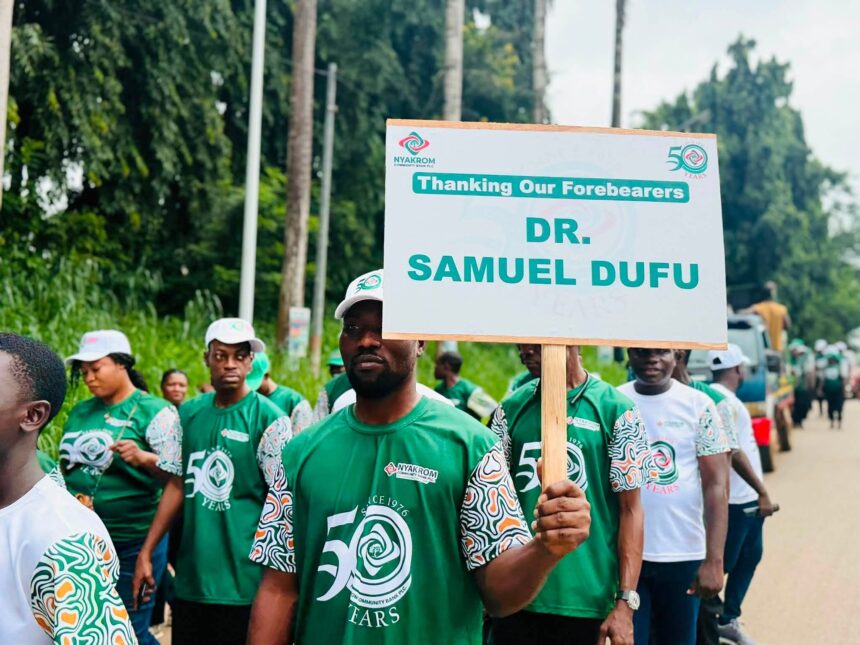
 Nyakrom Community Bank PLC celebrates its Golden Jubilee.
Behind the numbers are thousands of untold stories—a farmer who expanded production through a loan, a trader who grew a small business into a thriving enterprise, parents who financed their children’s education through disciplined savings, and communities that benefited from the bank’s investments in schools, health and social infrastructure.
The bank’s journey mirrors Ghana’s own financial evolution. From passbooks and manual ledgers to mobile banking, USSD services and digital financial solutions, Nyakrom Community Bank has continually adapted to meet the changing needs of its customers while remaining rooted in its founding mission of community development.
The Golden Jubilee also coincides with the 50th anniversary of Ghana’s rural and community banking sector, making Nyakrom’s milestone a national one. Industry leaders describe the bank as the institution that transformed financial exclusion into opportunity and proved that community-owned banking could drive inclusive economic growth.
As dignitaries, customers and residents gather to celebrate this landmark, the occasion offers an opportunity to reflect on an enduring question: How did one rural bank in Agona Nyakrom become the foundation of a financial movement that continues to empower millions of Ghanaians?
Fifty years on, the answer lies not only in the bank’s balance sheet but in the communities it has helped build, the dreams it has financed and the legacy it continues to shape for the next generation.