

In a region where the battle for truth is becoming increasingly complex, journalists across West Africa are stepping forward to reclaim their role as defenders of credible information. From rising disinformation to shrinking civic space and mounting pressure on independent media—particularly across parts of the Sahel—the challenges are intensifying, demanding new skills, stronger collaboration, and renewed resilience.
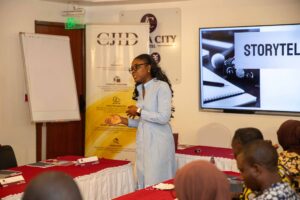
It is against this backdrop that the Centre for Journalism Innovation and Development (CJID) has convened journalists from Ghana, Nigeria, and The Gambia for the CJID SAIL+ (Soutien à l’Information Libre) three-day workshop focused on fact-checking, investigative reporting, and solutions journalism.
The workshop marks a critical intervention aimed at strengthening independent journalism and fostering cross-border collaboration in a region where misinformation and censorship increasingly threaten democratic discourse.
Related Stories

Opening the session, Maxine Danso underscored the urgency of the initiative, emphasizing the need to build a more resilient media ecosystem capable of withstanding evolving threats.
“This initiative is about strengthening the foundations of independent journalism across West Africa,” she noted. “We are creating a space where journalists can collaborate, share knowledge, and build the tools needed to navigate a rapidly changing and often hostile information environment.”
Her remarks set the tone for a program designed not only to enhance technical capacity, but also to reinforce the role of journalism as a pillar of accountability and public trust.
The first day of the workshop quickly moved into practical engagement, with a thought-provoking session led by Solomon Katachie of the London School of Economics and Political Science. His session explored the evolving nature of storytelling in journalism—challenging participants to rethink traditional approaches and embrace more nuanced, human-centered narratives.
Dr. Katachie highlighted the growing importance of “soft news” techniques within investigative reporting, particularly in an era where audiences are inundated with information but often disconnected from its human impact.
“It allows for context—it humanizes data, which is very important for investigative journalism,” he explained, urging journalists to move beyond rigid formats and adopt storytelling methods that resonate more deeply with audiences.
Participants engaged in discussions around what constitutes impactful journalism today, examining different styles—from hard investigative pieces to solutions-focused reporting—and how these can be adapted to counter disinformation and restore public confidence in the media.
Beyond technical training, the workshop represents a strategic effort to build networks among journalists across borders—recognizing that many of the challenges facing the media, from fake news to political pressure, are not confined by national boundaries.
As one participant observed during the session, “The threats we face are similar across our countries. Working together is no longer optional—it is essential.”
The CJID SAIL+ initiative comes at a time when the stakes for journalism in West Africa have never been higher. In parts of the Sahel, increasing insecurity and state control have tightened restrictions on press freedom, while digital platforms continue to amplify the spread of false information.
By equipping journalists with tools in fact-checking, investigative techniques, and solutions journalism, the program aims to empower media professionals to not only expose wrongdoing, but also highlight pathways for change—shifting the narrative from crisis to constructive engagement.
As the workshop continues over the next two days, participants are expected to deepen their skills, exchange experiences, and build lasting collaborations that extend beyond the training room.
In a region navigating uncertainty and complexity, one message is emerging clearly: the future of West African journalism will depend not only on courage—but on collaboration, innovation, and an unwavering commitment to truth.