
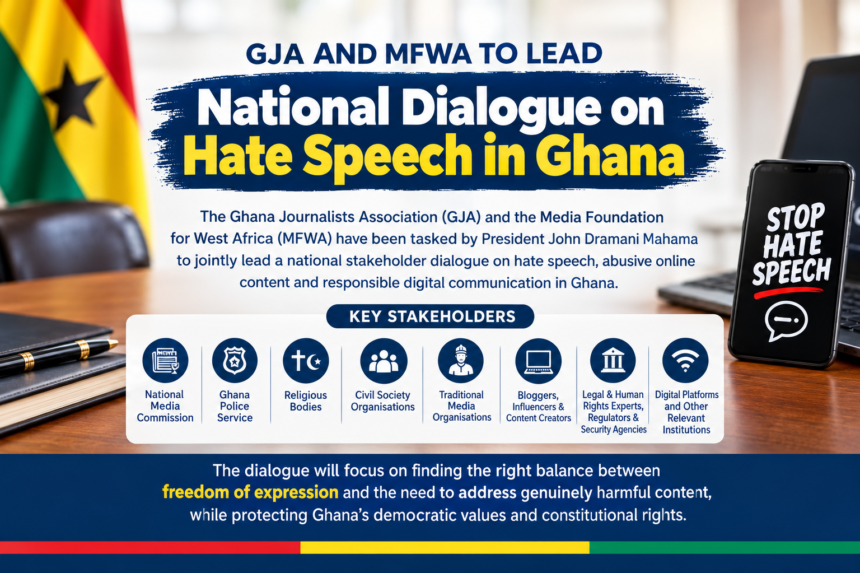
The Ghana Journalists Association (GJA) and the Media Foundation for West Africa (MFWA) have been tasked to jointly lead a national stakeholder dialogue on hate speech, abusive online content and responsible digital communication in Ghana.
The directive was issued by President John Dramani Mahama in a letter dated September 22, 2026, as concerns grow over the increasing influence of social media, bloggers, influencers and other digital content creators on public discourse.
The proposed dialogue is expected to bring together a broad range of stakeholders, including the National Media Commission, Ghana Police Service, religious bodies, civil society organisations, traditional media organisations, bloggers, influencers and social media content creators. Legal and human-rights experts, digital platforms and relevant regulatory and security institutions are also expected to participate.
Related Stories
Balancing free expression and harmful content
A key focus of the national engagement will be finding an appropriate balance between protecting freedom of expression and addressing genuinely harmful digital content.
The Presidency has stressed that while hate speech, threats, incitement to violence and other unlawful conduct must be addressed, measures taken must not criminalise legitimate criticism, political commentary, satire or dissent.
President Mahama also raised concerns about disproportionate arrests arising from criticism or politically charged commentary, arguing that responses to harmful speech should be appropriate to the nature of the conduct involved.
What the dialogue will examine
The GJA and MFWA are expected to coordinate discussions around:
- The adequacy of Ghana’s existing legal, regulatory and institutional framework;
- Clearer distinctions between lawful expression and unlawful speech;
- Practical guidelines for law-enforcement agencies;
- Policy, legislative and regulatory options;
- Public education and media and digital literacy;
- Professional and ethical standards for online content creators;
- Accessible complaints and redress mechanisms; and
- Alternatives to arrest and prosecution where conduct does not involve threats, incitement, violence or other clearly criminal acts.
The two organisations have also been asked to submit a proposed framework and timetable for the stakeholder engagement, together with recommendations emerging from the process, for consideration by the President.
An issue Ghana has debated before
The initiative builds on earlier national conversations about hate speech and media responsibility. In June 2023, the MFWA, in partnership with the National Peace Council, National Media Commission and National House of Chiefs, convened a forum on “Media, Hate Speech and Democratic Consolidation in Ghana.”
That forum called for broad national consultation and cautioned against rushing into legislation without sufficient consideration of its implications for freedom of expression. Among the recommendations were greater public education, stronger media capacity to identify and avoid amplifying hate speech, improved fact-checking and greater responsibility by political actors and other influential voices.
The new national dialogue therefore presents an opportunity to revisit those concerns in the context of Ghana’s rapidly changing digital environment, where the boundaries between traditional journalism, citizen-generated content and influencer-driven public communication are increasingly fluid.
For the GJA and MFWA, the task will be to help facilitate a broad national conversation capable of protecting Ghana’s constitutional commitment to freedom of expression while encouraging responsible communication and addressing content that genuinely threatens individuals, communities and public safety.
Available next action: Create a downloadable PDF file here in this chat containing the finalized decisions and immediate actions above