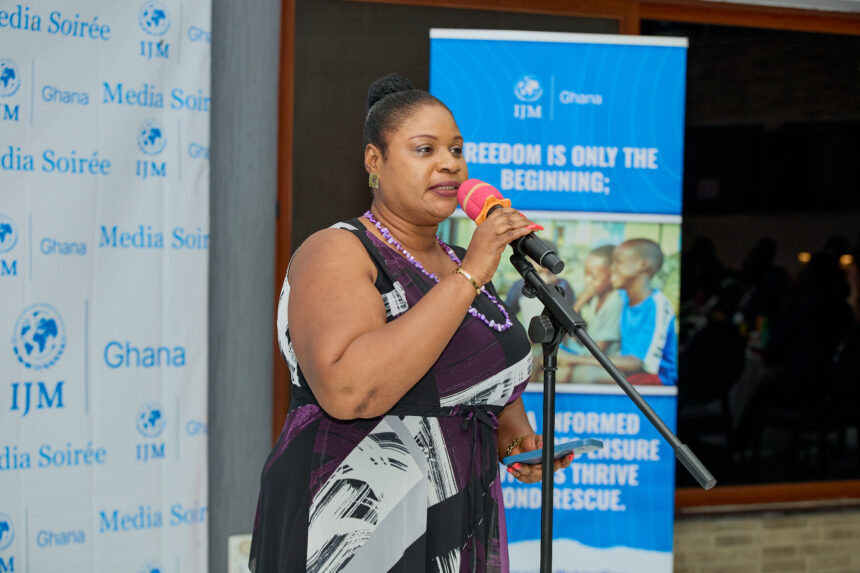
Vice President of the Ghana Journalists Association, Rebecca Ekpe, has called for stronger mental health and wellness support systems for journalists, particularly those reporting on traumatic issues such as human trafficking and child labour.


Speaking at a media training workshop organised by International Justice Mission (IJM) in partnership with the Greater Accra Chapter of the GJA in Accra, Rebecca Ekpe commended IJM for its commitment to building the capacity of journalists across the country on human trafficking and child protection reporting.
“I’d like to thank IJM for organising this training for journalists in Accra in partnership with the Greater Accra Chapter of the GJA,” she stated.
She recalled that the initiative followed recommendations made during a National Justice Conference and praised IJM for quickly responding with training programmes across different regions.
“I recall making this suggestion at the National Justice Conference and you quickly followed it up with a training in Tamale, bringing together 50 journalists from all five regions of the north. Thank you very much,” she said.
According to her, the continuous engagement of journalists on issues of trafficking and child labour is necessary to strengthen public awareness and accountability.
“I was in Ho for the Volta and Oti training as well and here today for the Accra session,” she added.
Rebecca Ekpe further urged journalists to approach the reporting of human trafficking and child labour with seriousness, professionalism, and empathy.
“I’d like to thank my colleagues for availing themselves for this training and urge that we take the reporting of human trafficking and child labour seriously,” she emphasized.
She also highlighted the emotional and psychological burden associated with journalism, especially for reporters who regularly cover distressing and traumatic stories.
As part of measures to support media practitioners, she appealed to IJM to consider organising wellness programmes for journalists.
“I’d like to appeal to IJM to consider organising a wellness day for journalists where we would have access to counselors and psychologists and engage in some activities that will make us release the stress and feel refreshed,” she said.

Rebecca Ekpe stressed that the well-being of journalists must not be overlooked, especially in trauma-sensitive reporting.
“A trauma-informed journalist is one whose well-being is also taken care of,” she noted.
She further called on managers and owners of media houses to institutionalise Employee Assistance Programmes to support journalists facing emotional and psychological challenges.
“Let me use this opportunity to urge managers of media houses to institutionalise Employee Assistance Programmes to help deal with emotional and psychological issues that journalists face. That will be a more sustainable approach,” she stressed.
Rebecca Ekpe concluded by encouraging journalists to continue deepening their understanding of trafficking-related issues and recommended the latest Trafficking in Persons (TIP) Report released by the United States authorities as a useful resource.
“I also encouraged us to check out the latest TIP Report — the Trafficking in Persons report released by the U.S. State Department,” she added.