
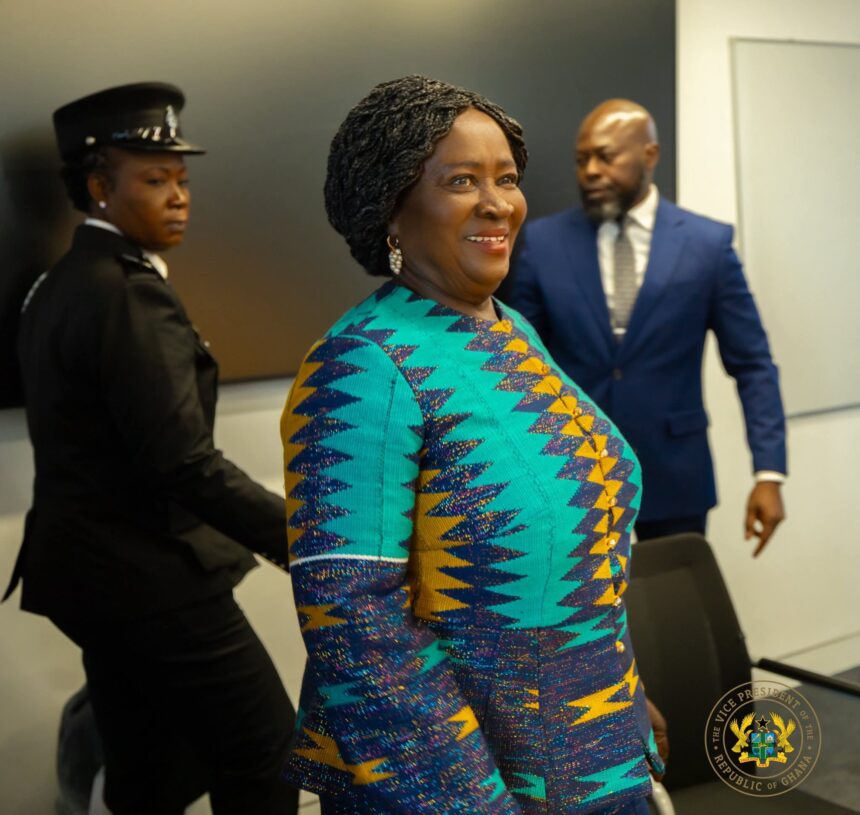
Jane Naana Opoku-Agyemang has reaffirmed the critical role of young Africans in shaping the continent’s future during an engaging interaction with Ghanaian students at the University of Oxford in the United Kingdom.
Speaking during her visit to Oxford, the Vice President described the meeting as refreshing and inspiring, noting that the ideas, curiosity, and ambition of young Ghanaians abroad continue to offer hope for the country’s future development.
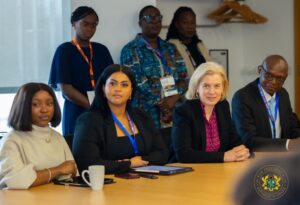 Professor Jane Naana Opoku Agyemang meets with students of University of Oxford, UK.
The discussions focused on leadership, education, identity, and the responsibility of African youth in an increasingly interconnected world. Prof. Opoku-Agyemang encouraged the students to broaden their perspectives beyond their individual academic disciplines, stressing that modern global challenges demand integrated thinking, innovation, and collaborative solutions.
According to her, education extends beyond formal classroom learning and must include experiential engagement, social interaction, and exposure to diverse viewpoints that help shape both ideas and character.
The Vice President also reflected on the role of women in leadership, urging the students to critically examine inherited systems and long-held assumptions about gender and governance. She observed that African societies historically had women occupying influential positions as healers, custodians of justice, and leaders within communities.
She emphasized that culture should not be viewed as static, but rather as dynamic and evolving, adding that societies must continually assess what traditions and practices should be preserved or discarded in the interest of progress and inclusion.
Prof. Opoku-Agyemang further highlighted the importance of dignity and compassion in leadership, calling on the students to remain sensitive to the needs of vulnerable and underserved populations.
The conversation also explored the role of the Ghanaian diaspora in national development. She noted that contributions from Ghanaians abroad should go beyond financial remittances to include mentorship, knowledge transfer, innovation, and institutional support aimed at strengthening the country’s development agenda.
On education and skills development, the Vice President underscored the need to strengthen special education and vocational training to build local capacity, reduce dependence on imports, and equip young people with practical skills relevant to national growth.
The interaction, she noted, reaffirmed the importance of creating platforms that keep young Ghanaians abroad connected to national conversations and development efforts.