
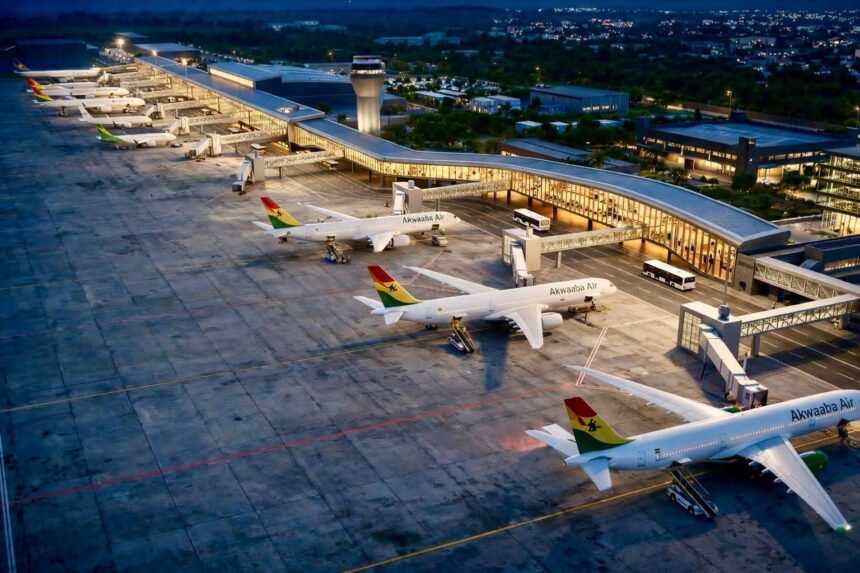
President John Dramani Mahama stepped onto the tarmac at Kotoka International Airport just after sunrise, the hum of engines blending with the sharper rhythm of construction work already underway. The morning air carried a mix of jet fuel and fresh concrete—a fitting symbol of transition.
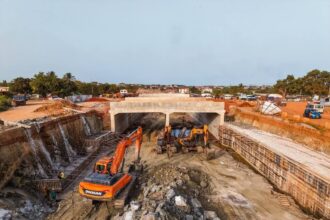
Around him, cranes stretched into the sky like steel giraffes, and workers in reflective vests moved with purpose. The airport, long considered Ghana’s gateway to the world, had become a hive of transformation.
“This is not just about buildings,” Mahama said, pausing to look across the site, his voice steady but reflective. “It’s about how Ghana presents itself to the world—and how we welcome the world back.”
Related Stories

Officials, engineers, and media clustered nearby as he was guided toward a ceremonial space marked for the sod-cutting. A polished shovel stood ready, its metallic surface catching the early light.
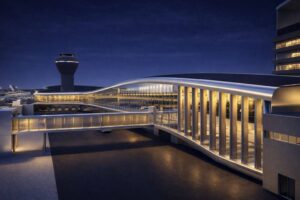
The project at the heart of the morning’s visit was ambitious: a new concourse linking Terminals 2 and 3, designed to ease congestion and elevate passenger experience. But beyond the technical drawings and architectural renderings, there was a sense of something larger taking shape.
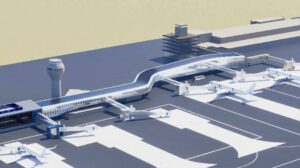
One of the engineers, gesturing toward a large display board, explained, “This concourse will fundamentally change passenger flow. Five new boarding bridges, modern holding areas, seamless movement—it’s about efficiency and comfort.”
Mahama nodded, then turned slightly toward the gathering. “We are building not just for today,” he said, “but for decades to come. Air travel is growing, and Ghana must be ready.”
As the ceremony began, a hush settled. The President grasped the shovel and pressed it into the earth. Cameras clicked rapidly.
“With this sod,” he declared, lifting a small mound of soil, “we break ground on a future where travel through Accra is smoother, faster, and worthy of our nation’s aspirations.”
Applause rippled through the crowd.
Nearby, a young airport worker watched intently. “I’ve worked here five years,” he said quietly to a colleague. “If this comes together the way they say… it’ll be a whole new place.”
The plans for the concourse promised a modern travel experience: five passenger boarding bridges to reduce reliance on buses, spacious holding areas to ease crowding, and bi-directional travelators to keep movement fluid. Escalators and elevators would ensure accessibility, while a VIP lounge and multiple business lounges would cater to different classes of travelers.
Retail and duty-free pods would add a commercial dimension, transforming waiting time into an experience rather than a delay.
As the event wound down, Mahama took a final look at the site. For a moment, the noise of machinery seemed to fade beneath the weight of possibility.
“Progress,” he said to no one in particular, “is not always quiet. Sometimes, it sounds exactly like this.”
And as another aircraft roared overhead, climbing into the bright Accra sky, the message felt unmistakable: the future of Ghana’s aviation hub was already under construction.