
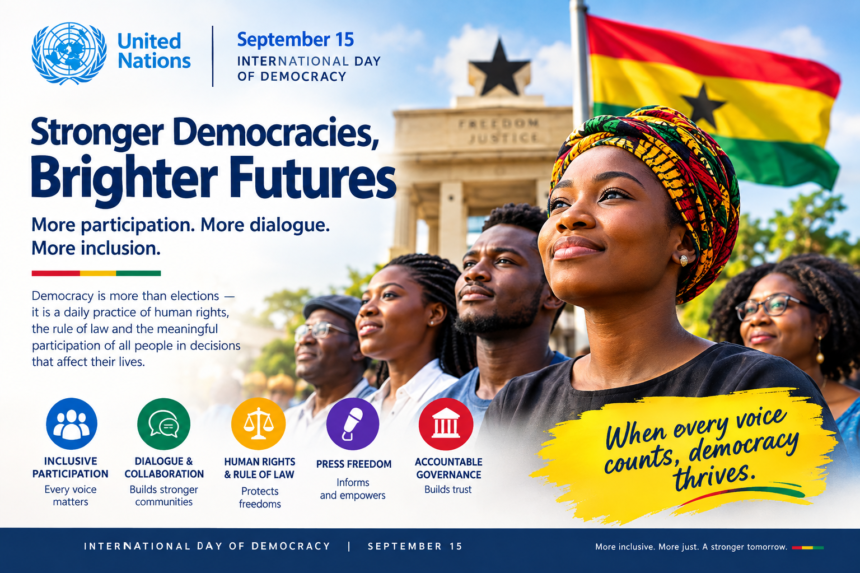
The world today marks the International Day of Democracy, with renewed calls for greater citizen participation, respect for human rights and stronger democratic institutions.
Observed annually on September 15, the Day was established by the United Nations General Assembly in 2007 to provide an opportunity to assess the state of democracy around the world and promote efforts to strengthen and consolidate democratic governance.
This year’s observance places particular emphasis on deliberative democratic processes—creating meaningful opportunities for citizens from different backgrounds to participate in public decision-making through dialogue, collaboration and the exchange of diverse perspectives.
UN Secretary-General António Guterres says democracy must be understood as more than elections, stressing that it is a daily practice grounded in human rights, the rule of law and meaningful participation in civic and political life.
He warned that deepening divisions, declining trust and weakening relationships between citizens and governments are placing pressure on democratic systems worldwide.
“Each time we choose dialogue over division, and cooperation over confrontation, we strengthen democracy,” Mr Guterres said.
A call for every voice to count
The United Nations says inclusive participation can strengthen public trust and lead to more responsive and effective governance.
The 2026 observance is therefore highlighting the importance of giving citizens genuine opportunities to influence decisions that affect their lives, including through citizens’ assemblies and other forms of deliberative democracy.
The UN also continues to emphasize the important relationship between democracy, human rights and press freedom. Freedom of expression and access to information are essential to enabling citizens to participate meaningfully in democratic processes.
For journalists and media organisations, the day serves as a reminder of the responsibility to provide citizens with accurate, credible and diverse information while holding public institutions accountable.
Democracy and Ghana
In Ghana, where democratic governance has been sustained through successive constitutional transitions and elections, the International Day of Democracy offers an opportunity to reflect on the country’s democratic journey and the need to continuously strengthen institutions.
It also highlights the importance of political tolerance, responsible journalism, civic education, youth participation, women’s representation, accountability and respect for the rule of law.
As Ghana and other democracies confront misinformation, political polarisation and declining public trust in institutions, stakeholders are being encouraged to make democratic participation more inclusive and meaningful.
The International Day of Democracy ultimately serves as a reminder that democracy is not only about voting on election day—it is about ensuring that citizens have a voice, their rights are protected and governments remain accountable to the people.
As the UN puts it, when every voice counts, democracy can deliver peace, dignity, inclusion and more resilient societies.