
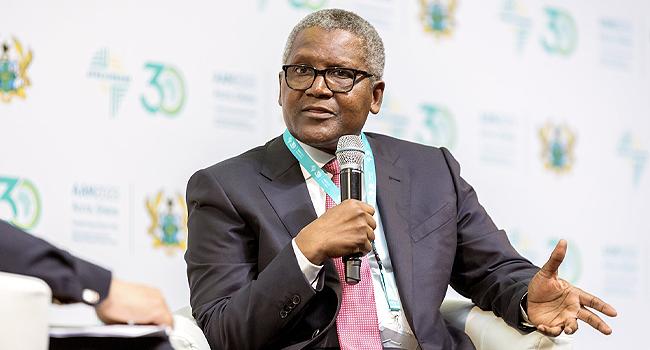
Africa’s richest man, Aliko Dangote, has brought renewed attention to Ghana’s investment potential following his participation in the maiden Invest Ghana Summit 2026 in Accra, with proposed investments in sugar production, cocoa processing and rice processing raising prospects for industrial expansion, job creation and increased local production.
The Nigerian billionaire joined President John Dramani Mahama at the two-day summit, held from November 16 to 17, 2026, at the Kempinski Hotel Gold Coast City in Accra.
His presence comes at a time when Ghana is seeking to attract approximately 10 billion US dollars in investments under its New Economy Programme, aimed at strengthening productive sectors, expanding manufacturing, increasing exports and creating employment.
Related Stories

But beyond the prestige of hosting one of Africa’s most influential business figures, the bigger question is what his investment ambitions could mean for Ghana’s economy and ordinary Ghanaians.
Who is Aliko Dangote?
Born on April 10, 1957, in Kano, Nigeria, Dangote comes from a prominent business family. He developed an interest in commerce at an early age and began his entrepreneurial journey by trading commodities, including sugar, rice and cement.
In 1977, he established what would eventually become the Dangote Group, which has grown into one of Africa’s largest industrial conglomerates.
His business interests span:
-
Cement manufacturing and distribution.
-
Sugar refining and food processing.
-
Fertilizer production.
-
Oil refining and petrochemicals.
-
Salt and other consumer products.
One of his most ambitious projects is the Dangote Petroleum Refinery, located in Lekki, Nigeria. The refinery represents a major effort to reduce Nigeria’s dependence on imported petroleum products and strengthen domestic refining capacity.
His business philosophy centres on investing in large-scale African industries, producing locally, reducing dependence on imports and developing businesses capable of serving markets across the continent.
His visit to Ghana therefore represents more than a high-profile business appearance. It brings into focus the possibilities of African capital driving African industrialisation.
What did Dangote bring to the Invest Ghana Summit?
Among the major proposals and discussions are:
1. Sugar production and processing
The Dangote Group is proposing a major sugar investment in Ghana, with the project expected to create nearly 50,000 jobs, according to reports from the summit.
The proposed ownership structure involving the government, the Dangote Group and Ghanaian stakeholders is still to be finalized.
The investment is expected to support local sugar production and reduce Ghana’s dependence on imported sugar.
2. Cocoa processing
Dangote is also exploring collaboration with the Ghana Cocoa Board (COCOBOD) to process approximately 500,000 metric tones of cocoa locally.
This is particularly significant because Ghana has traditionally exported a substantial proportion of its cocoa in raw or semi-processed form.
Local processing into cocoa butter and other value-added products could increase the value Ghana derives from its cocoa industry.
3. Rice processing
The summit also featured plans for large-scale rice processing, with Dangote’s group expected to handle approximately one million tones, alongside another 500,000 tones associated with Farouk’s group, according to reporting on the announcements.
Borderless Alliance President
These proposals could strengthen Ghana’s domestic food-processing capacity and support the government’s agricultural transformation agenda.
Important distinction: These are investment proposals and discussions, not evidence that all the projects have secured financing, completed agreements or begun construction.
What are the potential impacts on Ghana’s economy?
The significance of Dangote’s interest in Ghana goes beyond the amount of money that may be invested. It touches on some of the country’s longstanding economic challenges.
1. Job creation and employment opportunities
The proposed sugar project, with an estimated 50,000 jobs, could create opportunities across agriculture, manufacturing, transportation, engineering, distribution and other supporting industries.
For young people, this could mean opportunities for technical training, factory employment, logistics, agricultural production and entrepreneurship.
However, the real measure of success will be how many of these jobs go to Ghanaians, how many are permanent and how many offer decent wages and career progression.
2. Reduction in imports and pressure on foreign exchange
Ghana spends substantial amounts of foreign exchange importing products that could potentially be produced or processed locally.
If the proposed sugar and rice investments become operational, Ghana could reduce some of its import requirements.
This could:
-
Reduce demand for foreign exchange to pay for imported food products.
-
Support greater stability in the balance of trade.
-
Reduce exposure to international supply disruptions.
-
Strengthen domestic food security.
But import substitution will only deliver these benefits if local production is competitive in terms of price, quality and volume.
3. Value addition to Ghana’s cocoa industry
This is perhaps one of the most strategically important aspects of the proposed investment.
Ghana is one of the world’s leading cocoa-producing countries, yet the country has historically struggled to capture enough value from processing its cocoa into finished and semi-finished products.
Processing 500,000 tonnes locally would represent a major industrial undertaking if the proposal is implemented at the stated scale.
Instead of exporting predominantly raw cocoa beans, Ghana could expand production of:
-
Cocoa butter.
-
Cocoa powder.
-
Chocolate and confectionery.
-
Other cocoa-based industrial products.
The economic implications include higher export earnings, industrial employment, technology transfer and opportunities for Ghanaian businesses to participate in international cocoa value chains.
It could also strengthen Ghana’s ambition to become a major centre for cocoa processing rather than simply a supplier of raw agricultural commodities.
4. A boost for Ghanaian farmers
Large-scale processing facilities need reliable supplies of agricultural raw materials.
This could create a dependable market for sugarcane growers, rice farmers and cocoa producers.
For farmers, the benefits could include:
-
More predictable markets.
-
Increased demand for agricultural produce.
-
Opportunities for contract farming.
-
Improved access to processing and storage infrastructure.
-
Increased incentives to expand production.
However, factories alone will not transform agriculture. Ghana must also invest in irrigation, improved seeds, mechanization, extension services, storage and rural roads.
5. Industrialization and technology transfer
Dangote’s business model is built around large-scale manufacturing and industrial integration.
His investments could introduce new production technologies, industrial management systems, technical expertise and supply-chain practices.
Ghanaian companies could benefit through partnerships, subcontracting, equipment supply, logistics and maintenance services.
This could help develop local industrial capacity and strengthen Ghana’s ability to manufacture products for the wider African market.
6. Strengthening Ghana’s position under AfCFTA
Ghana hosts the Secretariat of the African Continental Free Trade Area (AfCFTA).
This gives Ghana an opportunity to position itself as a manufacturing and distribution hub serving the wider African market.
If Dangote establishes competitive production facilities in Ghana, the country could become a base for supplying neighboring West African markets and other destinations across the continent.
That could increase exports, attract additional investors and strengthen regional trade.
What are the implications and risks Ghana must consider?
While the potential benefits are significant, Ghana must approach these proposed investments with careful economic planning and negotiations.
1. Avoiding excessive dependence on one conglomerate
Dangote’s expanding interests across cement, sugar, cocoa and other sectors raise questions about market concentration.
Investment is welcome, but Ghana must ensure that its strategic industries do not become excessively dependent on one corporate group.
Competition must be protected, and Ghanaian businesses must have room to grow.
2. Protecting local businesses
Large foreign investors can bring capital, technology and expertise. However, they can also place pressure on smaller domestic businesses that may struggle to compete.
Government must ensure that Ghanaian manufacturers, processors and entrepreneurs are not pushed out of the market.
Partnerships, local procurement requirements and access to finance for domestic enterprises will be important.
3. Ensuring that the jobs benefit Ghanaians
The proposed 50,000 jobs are attractive, but Ghana must demand clarity on the employment arrangements.
How many will be direct jobs? How many will be indirect? What percentage will go to Ghanaian workers? What training opportunities will be provided?
The country must move beyond headline employment projections to measurable commitments.
4. Transparency in investment agreements
Ghana must negotiate agreements that protect its national economic interests.
This includes examining:
-
Tax incentives and exemptions.
-
Land acquisition arrangements.
-
Environmental and social safeguards.
-
Local ownership and participation.
-
Technology transfer.
-
Employment conditions.
-
Profit repatriation.
-
Competition and market access.
The public should understand the obligations and benefits associated with major investments, particularly where public resources or incentives are involved.
5. Ensuring that farmers are not disadvantaged
Industrial expansion must not come at the expense of farmers.
For cocoa, sugarcane and rice, procurement arrangements must guarantee fair and transparent pricing, timely payments and sustainable production.
The interests of farmers must remain central to the investment agreements.
The bigger economic question: Will Ghana benefit or simply host another big investor?
The visit also raises an important question about the relationship between foreign investment and national economic development.
Ghana should not measure the success of Dangote’s visit by the billionaire’s presence at the summit, the announcements made or the size of proposed investments.
The real test will be whether the investments translate into factories, jobs, exports, improved livelihoods and stronger Ghanaian businesses.
There is also an opportunity for Ghana to learn from Nigeria’s industrialization experience. Dangote’s business expansion demonstrates how African entrepreneurs can move from commodity trading into large-scale manufacturing.
However, Ghana must avoid creating an economic environment in which a few large companies dominate strategic industries at the expense of competition.
Five questions Ghana must ask?
-
How much actual capital will Dangote invest in Ghana, and over what period?
-
What percentage of the proposed investments will be owned by Ghanaian partners?
-
What guarantees will be provided for local employment, technology transfer and procurement?
-
How will Ghanaian farmers and existing processors benefit?
-
What safeguards will protect competition, consumers and the national interest?
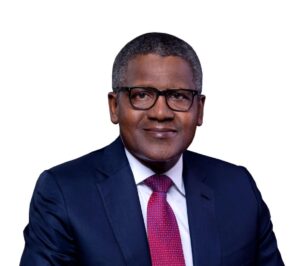 Aliko Dangote.
The Ghana–Dangote relationship: An interesting personal connection
An interesting revelation at the summit was Dangote’s disclosure that approximately one-quarter of his family members were born in Ghana.
He described Ghana as a second home, adding a personal dimension to his business interests in the country.
This connection could provide an additional foundation for stronger commercial relationships between Ghana and Nigeria
An opportunity Ghana must convert into economic transformation
Dangote’s visit presents Ghana with an opportunity to attract major African capital, accelerate industrialization and strengthen its position as a regional manufacturing and investment destination.
But investment attraction must be followed by investment delivery.
Ghana needs more than announcements. It needs functioning factories, competitive industries, thriving local businesses, decent jobs and increased export earnings. The country must also ensure that its farmers, young people, entrepreneurs and local investors are active participants in the economic opportunities being created.
The ultimate question is not how wealthy Aliko Dangote is or how much attention his visit attracts. It is how much wealth his investments can help create for Ghana and how fairly that wealth will be distributed.
That is the real measure of whether the Dangote investment ambitions will contribute meaningfully to Ghana’s economic transformation.
More below:
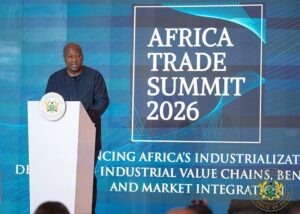
Africa Trade Summit 2026: Mahama calls for bold reforms to accelerate Africa’s development