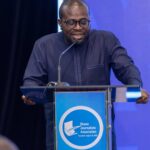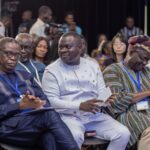

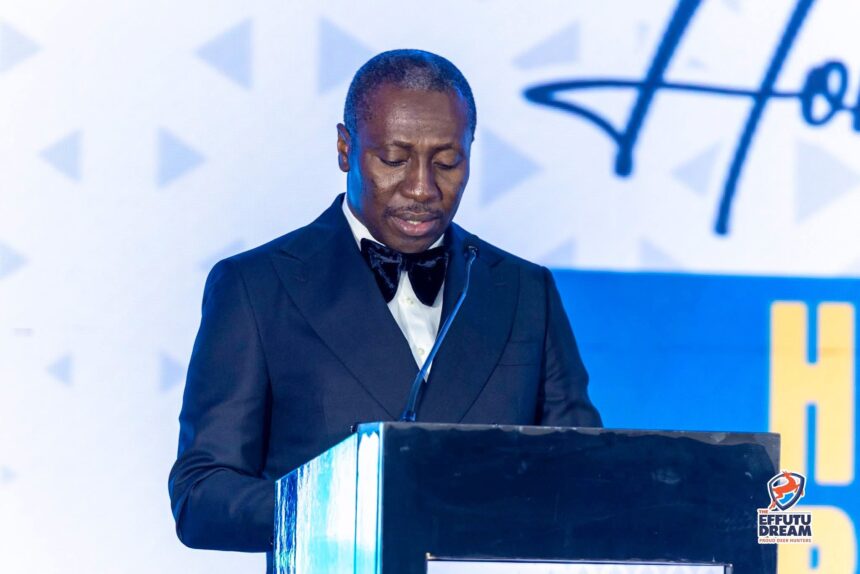
Minority Leader in Parliament, Osahen Alexander Kwamena Afenyo-Markin, used the World Press Freedom Day Commemoration and Honours Night to deliver a sweeping address on the state of media freedom in Ghana, weaving together history, constitutional law, and urgent warnings about the weaponisation of criminal law against speech.
He opened by acknowledging GJA President Albert Kwabena Dwumfour, Honourable Ministers, members of the Diplomatic Corps, UN representatives, media practitioners, veteran journalists, and development partners. He called it a distinct honour to join the event to mark World Press Freedom Day and to celebrate veteran journalists and partners whose sacrifices and dedication helped shape Ghana’s democratic journey. He commended the Ghana Journalists Association for defending the frontiers of media freedom, professional journalism, and democratic accountability, noting that the media sits at the very heart of democracy, development, peace and national cohesion.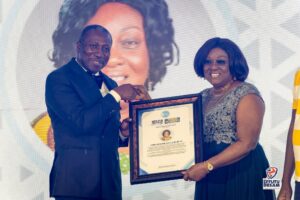
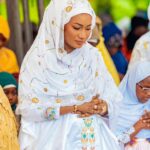
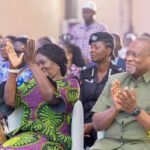
 Hon Afenyo Markin -MP-Minority Leader of Parliament presents Press Fredom Honours to Gina Blay, Veteran Journalist.
Hon Afenyo Markin -MP-Minority Leader of Parliament presents Press Fredom Honours to Gina Blay, Veteran Journalist.*The Roots of the Day*
Afenyo-Markin recalled the origins of World Press Freedom Day. In April 1991, journalists from 38 African countries met in Namibia and, on 3rd May, produced the Windhoek Declaration, a landmark statement of principles on press freedom. Later that year, UNESCO’s General Conference endorsed the declaration, and in 1993, the United Nations General Assembly proclaimed 3rd May as World Press Freedom Day. Since then, the day has been used to raise awareness about why a free and independent media matters, to push for better protection of journalists, and to address new challenges like misinformation, digital safety, and technology’s impact on journalism.
*The Fourth Estate*
Anchoring his remarks on the theme “Shaping a Future at Peace: Promoting Press Freedom for Human Rights, Development and Security,” he turned to the media as the Fourth Estate of the Realm. The concept dates back to 18th Century political thought, credited to Anglo-Irish statesman Edmund Burke, who pointed to the press gallery in the British Parliament and said, “Yonder sits the Fourth Estate, and they are more important than them all.” The First Estate is the Executive, the Second the Legislature, the Third the Judiciary. The Fourth Estate watches them all. It is the sentinel that never sleeps.
Ghana’s 1992 Constitution backs that role. Article 162(1) guarantees the freedom and independence of the media. Article 162(3) protects the establishment and operation of private media without unnecessary state impediments. Article 21(1)(a) gives every citizen the right to freedom of speech and expression, including freedom of the press. Any attempt to intimidate, harass, arrest, or suppress a journalist for performing their legitimate constitutional duty is an attack not only on that individual but on the Constitution itself.
*Media as an Instrument of Peace*
He rooted the theme in the broader architecture of peace, citing Rwanda as a searing example. Radio Milles Collines broadcasted hatred, called people cockroaches, and directed killers to their victims’ homes. Eight hundred thousand souls perished in one hundred days. The lesson is clear: when the media becomes a weapon of division rather than a bridge of understanding, nations burn. True journalism resists exaggeration and rejects sensationalism. Quoting American journalist Walter Lippmann in _The Liberty and the News_, he reminded the room that “there can be no higher law in journalism than to tell the truth and to shame the devil.”
*The Chilling Effect*
Even as they celebrated, he urged candour about today’s threats. Since the NDC administration assumed office in January 2025, a pattern has emerged. Party officials, colleagues, and social media commentators have gone through arrest, charges, summons, and threats for what they have said on air, online, or in public. The charges vary: causing fear and panic, publication of false news, offensive conduct, seditious libel. The offences differ, but the target stays the same: speech, criticism, and the political opposition’s ability to hold government accountable.
He has watched colleagues walk into police stations, signed bail himself, and watched families spend sleepless nights. Studios have grown quieter, not because people have nothing to say, but because they fear what happens when they say it. You do not silence speech by banning it outright in a constitutional democracy, because the courts would strike it down. Instead, you make speech costly. Arrest one person, and ten others watch. Prosecute one journalist, and a hundred others self-censor. Scholars call this the chilling effect, and it is operating in Ghana today.
*Weaponised Laws*
In the first sixteen months of this Government, fourteen people were arrested over speech and political commentary. At the center are Section 76 of the Electronic Communications Act, 2008, Act 775, on false information, and Sections 207 and 208 of the Criminal Offences Act, 1960, Act 29, on offensive conduct and publication of false news. These laws were enacted to preserve public order, but they are now being applied beyond their original intent.
David Essamdoh, Organiser of the NPP in Agona West Constituency, reportedly said “Dumsor is back” and was picked up by the Bureau of National Investigations. Baba Amando was also detained for public statements. These cases show a pattern where political speech, especially from opposition figures, has attracted unlawful arrest, detention, and interrogation. The Media Foundation for West Africa has warned that unlawful arrest and detention as a first resort creates a chilling effect on democratic participation.
*The Prosecutor as Censor*
Some laws, he argued, were never designed to protect citizens from crime, but to protect governors from the governed. They were instruments of colonial control, and though Ghana has moved beyond that past, those laws have not yet been consigned to the museum where they belong. The Supreme Court, in _New Patriotic Party v. Inspector General of Police_, affirmed the constitutional right to demonstrate and hold public discourse. The trajectory of Ghanaian jurisprudence is clear: criminal law should not be the first resort when words cause offence. In most cases, it should not be a resort at all.
He was not claiming every person arrested is a saint. If someone commits a genuine crime, the law must take its course, fully, fairly, and in accordance with the Constitution. What he is contesting is the consistent, disproportionate, and politically targeted deployment of the machinery of criminal prosecution against a political constituency, against people whose only weapon is their voice. That is the weaponisation of criminal law against free expression, and it must be named, resisted, and reversed.
He then addressed the role of the Attorney-General. Article 88(3) vests the Attorney-General with sole responsibility for the initiation and conduct of all criminal prosecutions. Article 88(4) states that offences prosecuted in the name of the Republic shall be at the suit of the Attorney-General or any person authorised by him. That is an enormous power, and it demands extraordinary restraint. The power to prosecute is the power to punish, not merely upon conviction, but from the moment of arrest. A person charged loses reputation before a verdict, loses time, income, and professional standing, and lives under the shadow of a courtroom for months or years. The family pays the price. The voice goes quiet.
*A Call to Action*
Article 296 of the Constitution requires that discretionary power be exercised fairly and candidly, not arbitrarily, capriciously, or biased by resentment, prejudice, or personal dislike. Articles 88 and 296 together establish a clear standard: the decision to prosecute must be fair, candid, and free from political motivation. When prosecutorial power is deployed selectively against critics while ignoring equivalent conduct by government supporters, it is not merely unjust, it is unconstitutional.
He therefore called on the Attorney-General to discharge the functions of that office fairly, candidly, and without prejudice. He called on the Director of Public Prosecutions to ensure that decisions to prosecute speech-related cases are subject to rigorous independent review. And he called on the judiciary to remain a bastion of independence, not an instrument of executive vengeance.
*Conclusion*
He closed by congratulating all award winners. “You have been our vanguard. Our veteran journalists, your years of sacrifice have earned you a great name. It has saved our republic.”
God bless all journalists and media practitioners of our Republic. God bless our homeland Ghana and make her great and strong.