
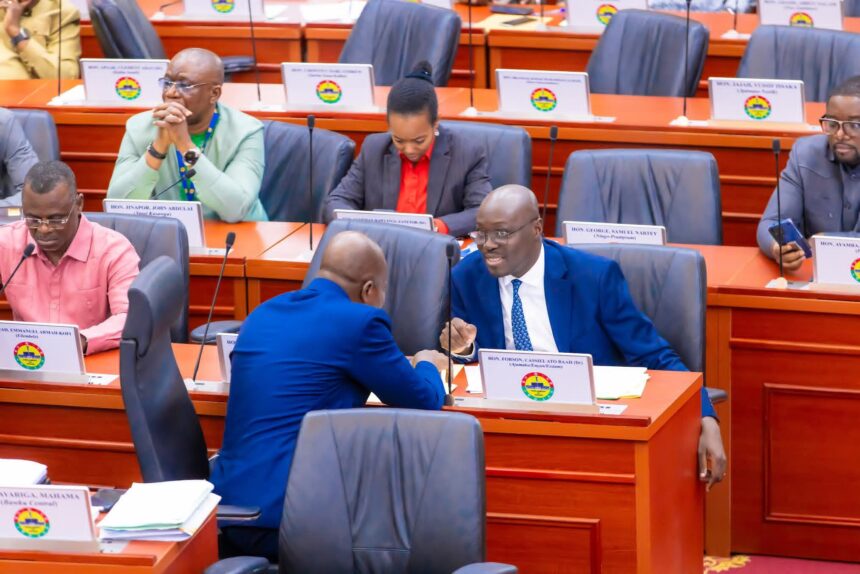
The Government has announced a major shift in Ghana’s economic relationship with the International Monetary Fund (IMF), declaring that the country has successfully restored macroeconomic stability and will no longer require a financial bailout in the foreseeable future.
Presenting a statement before Parliament, the Finance Minister said Ghana had moved from “dependence on financial bailout to partnership in reform,” describing the development as a significant milestone under President John Dramani Mahama’s Reset Agenda.
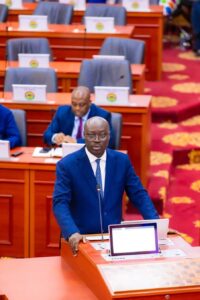
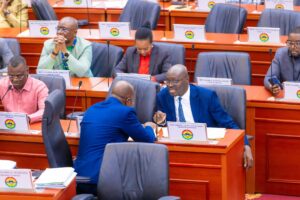
According to the Minister, the country has successfully concluded the final review of the current IMF Extended Credit Facility programme, pending approval by the IMF Executive Board, and will now transition to a non-financing Policy Coordination Instrument (PCI).
The Minister explained that the PCI framework would allow Ghana to continue engaging the IMF through policy coordination and reform monitoring without accessing bailout funds.
“Ghana has evolved from a position of supplicant to one of partner,” the Minister declared.
He further stressed that “no further IMF financial bailout will be required in the foreseeable future,” emphasizing that the country’s economic recovery had exceeded original programme targets.
Addressing Parliament, the Minister recounted the depth of the economic crisis inherited from 2022, when Ghana sought IMF support amid spiraling inflation, a depreciating cedi, rising debt levels, and loss of access to international capital markets.
He recalled that the crisis triggered multiple sovereign credit rating downgrades by international agencies, while the government at the time introduced the Domestic Debt Exchange Programme (DDEP), which imposed significant losses on bondholders, including pensioners.
“The consequences were felt across households, businesses, and institutions through rapid depreciation of the cedi, runaway inflation of more than 50 percent, erosion of incomes and savings, job losses, business distress, and weakened investor confidence,” he stated.
The Minister also criticized the previous administration for what he described as fiscal indiscipline, waste, and corruption, arguing that the economic hardship suffered by Ghanaians stemmed from years of poor economic management.
“Never again should Ghana return to that path,” he said repeatedly on the floor of Parliament.
The government outlined several policy interventions implemented since assuming office to stabilize the economy and restore confidence.
Among the measures highlighted were tighter public financial management controls, amendments to fiscal responsibility laws, operationalization of the Sinking Fund, establishment of the Independent Fiscal Council, renegotiation of Independent Power Producer agreements, and the removal of taxes such as the E-Levy, Betting Tax, Emissions Levy, and VAT on motor insurance.
The administration also reduced the number of ministers from 123 to 60 and streamlined ministries from 30 to 23 as part of expenditure rationalization efforts.
The Minister said the reforms had yielded strong economic gains.
He disclosed that Ghana recorded 6.0 percent real GDP growth in 2025, with non-oil GDP growth reaching 7.6 percent — the highest in 14 years.
For the first time, Ghana’s economy crossed the US$100 billion mark in 2025, while the country’s public debt-to-GDP ratio reportedly declined from 61.8 percent in 2024 to 44.7 percent in 2025.
Inflation, which stood at 23.8 percent in December 2024, dropped sharply to 3.4 percent by April 2026, while Treasury bill rates and the monetary policy rate also declined significantly.
The Minister added that the cedi appreciated by 40.7 percent against the US dollar in 2025, while the current account balance recorded a surplus of 8.3 percent of GDP.
“These results affirm a simple but enduring truth: fiscal prudence and discipline always deliver results,” he told lawmakers.
He described macroeconomic stability as the foundation for jobs, incomes, investor confidence, and national prosperity.
The statement also referenced President Mahama’s remarks at the 77th Annual New Year School in January 2026, where the President expressed hope that Ghana’s latest IMF programme would be “the 17th and the last time” the country would seek a bailout from the Fund.
“It will definitely be the last time we go on our knees to beg for a bailout,” the President had stated.
The Finance Minister likened Ghana’s economic recovery to a patient leaving intensive care.
“In other words, Ghana has moved from the intensive-care unit (ICU) to the wellness center,” he remarked.
Looking ahead, the government announced plans to unveil a new long-term economic transformation agenda dubbed “The New Economy” in the 2027 Budget.
According to the Minister, the programme will focus on sustainable job creation, higher productivity, economic resilience, and broad-based prosperity.
He concluded by thanking Ghanaians for their patience and sacrifices throughout the economic recovery process and pledged that the government would remain committed to prudent economic management.
“We will continue the hard work of building the Ghana We Want,” he said