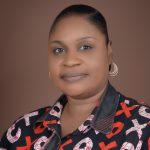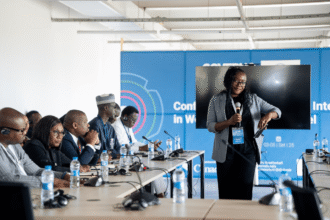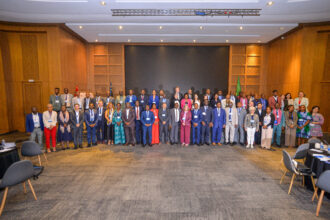

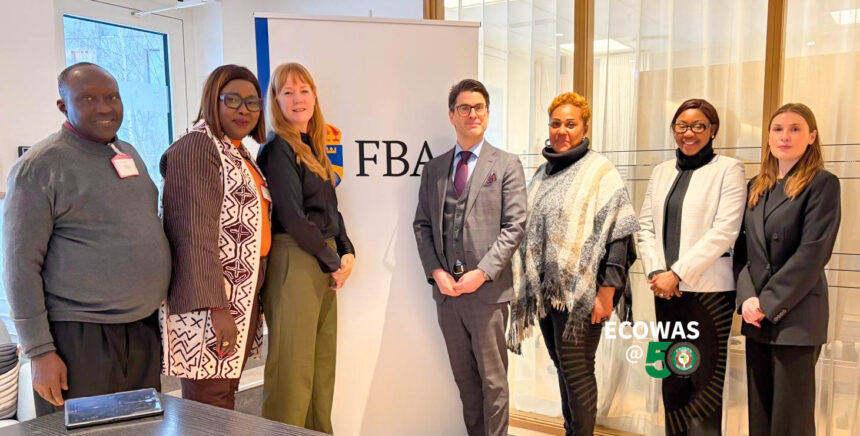
The ECOWAS Gender Development Center (EGDC) has conducted a working visit to the Folke Bernadotte Academy (FBA), the Swedish government agency for peace and security, in the Republic of Sweden. Led by Ms. Sandra Oulaté Fattoh, Director of the EGDC, the delegation was welcomed by the highest authorities of FBA, notably Mr. Per Olsson Fridh, Chief Executive Officer of FBA, and Mr.
Tobias Petrelius, Head of FBA’s Africa Unit, along with their colleagues. One of the objectives was to examine the mandates of the two institutions in order to strengthen and better coordinate the FPS Agenda within the ECOWAS structures responsible for this area.
The various discussions between the two delegations identified opportunities to improve coordination, streamline processes and strengthen gender-sensitive approaches in regional peace and security efforts. Other avenues for collaboration were discussed in relation to women’s leadership, including support for the EGDC’s Legacy Project on women’s political participation and leadership in ECOWAS and support for the ECOWAS Pre-Summit on ‘Women in Governance, Peace, Security and Regional Integration’; two topics that are among the key themes for discussion on the future of the Community, alongside the celebrations for the 50th anniversary of ECOWAS.
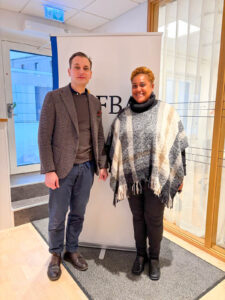
The mission was called upon to meet with the Head of the West Africa Division of the Africa Department of the Ministry of Foreign Affairs of the Republic of Sweden, Mr. Dario Jovic, and his team. A Memorandum of Understanding is currently being drafted to formalize the partnership between EGDC and FBA.
About ECOWAS:
Related Stories

The Heads of State and Government of fifteen West African Countries established the Economic Community of West African States (ECOWAS) when they signed the ECOWAS Treaty on the 28th of May 1975 in Lagos, Nigeria. The Treaty of Lagos was signed by the 15 Heads of State and government of Benin, Burkina Faso, Côte d’Ivoire, The Gambia, Ghana, Guinea, Guinea Bissau, Liberia, Mali, Mauritania, Niger, Nigeria, Sierra Leone, Sénégal and Togo, with its stated mission to promote economic integration across the region. The Senegalese President was represented by the Minister for Foreign Affairs. Cabo Verde joined the union in 1977. The only Arabic-speaking Member Mauritania withdrew in December 2000. Mauritania recently signed a new associate-membership agreement in August 2017. On January 29, 2025, Burkina Faso, Mali and Niger officially withdrew from ECOWAS. The current Member States of ECOWAS are Benin, Cabo Verde, Côte d’Ivoire, The Gambia, Ghana, Guinea, Guinea Bissau, Liberia, Nigeria, Sierra Leone, Sénégal and Togo. Considered one of the pillars of the African Economic Community, ECOWAS was set up to foster the ideal of collective self-sufficiency for its member states. As a trading union, it is also meant to create a single, large trading bloc through economic cooperation. Integrated economic activities as envisaged in the area that has a combined GDP of $734.8 billion, revolve around but are not limited to industry, transport, telecommunications, energy, agriculture, natural resources, commerce, monetary and financial issues, social as well as cultural matters. In 2007, ECOWAS Secretariat was transformed into a Commission. The Commission headed by the President, assisted by a Vice President, five Commissioners and the Auditor-General of ECOWAS Institutions, comprising experienced bureaucrats who are providing the leadership in this new orientation.
The ECOWAS budget is essentially financed by revenue collected through the Community tax. The tax was introduced to finance its activities. The rate of the Community levy is set at 0.5% of the CIF value of goods imported from
non-ECOWAS countries.
As part of this renewal process, ECOWAS is implementing critical and strategic programmes that will deepen cohesion and progressively eliminate identified barriers to full integration. In this way, the estimated 300 million citizens
of the community can ultimately take ownership for the realization of the new vision of moving from an ECOWAS of
States to an “ECOWAS of the People: Peace and Prosperity to All”. by 2050.