
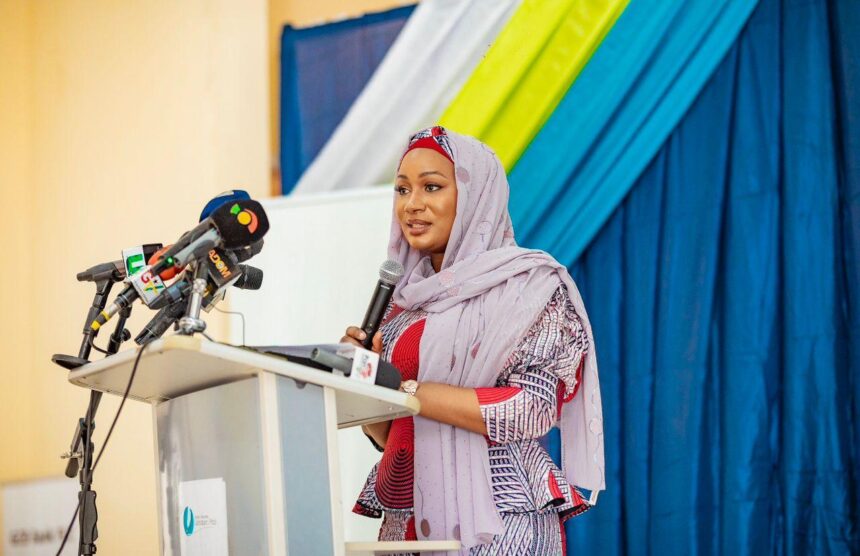
Former Second Lady takes maternal and newborn healthcare advocacy beyond birth kits, linking reliable electricity, renewable energy and safe childbirth.
Former Second Lady of Ghana, Hajia Samira Bawumia, is expanding her advocacy for maternal and newborn healthcare with a new initiative aimed at addressing one of the often-overlooked challenges facing healthcare delivery in underserved communities: unreliable electricity.
The initiative, known as the Powering Safe Delivery Initiative, seeks to provide solar energy systems and battery storage facilities to selected healthcare centres, particularly those where power interruptions could compromise emergency maternal and newborn care.
Related Stories

Launched at the World Health Organisation pavilion during the COP31 climate conference in Antalya, Türkiye, the initiative highlights the connection between climate action, access to energy and the right of women to safe childbirth.
The intervention is significant because electricity is not simply a convenience in a maternity facility. It is essential for lighting delivery rooms, operating medical equipment, preserving medicines and supporting healthcare professionals during emergencies, including night-time deliveries.
For women in remote and underserved communities, an unreliable power supply can add another layer of risk to an already challenging journey to safe motherhood.
The Powering Safe Delivery Initiative builds on the existing Safe Delivery Project under the Samira Empowerment and Humanitarian Projects (SEHP), which has distributed more than 11,000 birth kits to expectant mothers in underserved Ghanaian communities and trained 324 community-level personnel, including 164 health workers and 160 traditional birth attendants.
Mrs Bawumia believes that providing mothers with delivery kits and training birth attendants, while important, does not fully address the challenges confronting maternal healthcare if the facilities themselves lack dependable electricity.
Her argument is that maternal healthcare interventions must be comprehensive, addressing not only the needs of expectant mothers but also the infrastructure required by health professionals to provide emergency care.
The initiative will be implemented through the Africa Women and Youth Climate Centre (AFRYWOCC), established in collaboration with the Centre for Climate Change and Sustainability Studies at the University of Ghana and Minagie Energy.
Ghana is expected to serve as the starting point for a pilot programme, with ambitions to develop a model that could eventually be replicated in other African countries.

Climate change is also a women’s health issue
Beyond maternal healthcare, Mrs Bawumia used her participation at COP31 to advocate greater investment in clean cooking solutions, drawing attention to the health consequences of household air pollution, particularly for women and children who are disproportionately exposed to smoke from traditional cooking fuels.
She argued that climate change should not be viewed exclusively as an environmental concern but also as a public health and development challenge.
Her position reinforces the need for African countries to connect climate financing to practical interventions that improve living conditions, protect vulnerable populations and strengthen essential public services.
The bigger picture: Turning advocacy into measurable impact
For Ghana, the initiative presents an opportunity to rethink how maternal healthcare, renewable energy and rural development can work together.
However, its real success will depend on implementation.
How many health facilities will benefit? How will the initial installations be funded? Who will maintain the solar systems? And what mechanisms will ensure that the facilities remain operational long after the launch?
These are important questions for government, development partners, health authorities and the private sector.
Ghana has made considerable efforts to improve maternal healthcare access, but geographical inequalities and infrastructure challenges remain concerns. Reliable electricity in rural maternity facilities should therefore form part of the broader national conversation about quality healthcare.
For Samira Bawumia, the ambition appears to be moving from providing essential supplies to addressing the conditions under which mothers give birth.
Ultimately, the measure of this initiative will not be the international attention it receives, but the number of lives it helps protect.
Because no woman should lose her life bringing another life into the world simply because a health facility has no electricity