

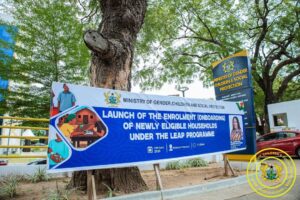
The Government of Ghana, through the Ministry of Gender, Children and Social Protection has officially launched the nationwide onboarding of 400,000 newly eligible households onto the Livelihood Empowerment Against Poverty (LEAP) programme, marking a major step in strengthening social protection delivery and expanding support to vulnerable populations.


Introduced in 2008, the LEAP Programme has evolved into one of Ghana’s flagship social protection interventions, growing from 1,654 households in 21 districts at inception to approximately 350,000 households nationwide prior to the current reassessment. The Programme supports extremely poor households, including older persons without support, orphans and vulnerable children, persons with severe disabilities and pregnant women and mothers with infants.
The current onboarding exercise follows a comprehensive nationwide reassessment conducted using the Ghana National Household Registry (GNHR), aimed at improving targeting accuracy, transparency and efficiency in the delivery of social assistance.
Delivering the keynote address, the Minister for Gender, Children and Social Protection, Hon. Dr. Agnes Naa Momo Lartey, described the launch as a “clear statement of commitment, reform and hope,” underscoring Government’s resolve to build a more responsive and credible social protection system.
She explained that the reassessment reflects the dynamic nature of poverty, where households may move in and out of vulnerability due to factors such as economic shocks, illness, job loss and climate-related challenges. As a result, while some households have been retained on the programme, 220,520 others will transition or exit after demonstrating improved living conditions or meeting established graduation criteria.
The Minister disclosed that, the nationwide onboarding exercise will commence on April 27, 2026. She noted that the process will involve rigorous validation of beneficiary data, registration onto secure payment platforms and verification to ensure accuracy and system integrity. “Payments to new beneficiaries will begin only after the enrolment process is fully completed to ensure transparency and accountability,” she stated.
Dr. Agnes Naa Momo Lartey further emphasised that the LEAP Programme has over the years played a critical role in supporting vulnerable households to meet basic needs, keep children in school, and access essential healthcare services. She added that the current exercise goes beyond numbers, representing improved lives, strengthened families and a renewed system designed to respond to evolving needs.
The Minister also outlines Government’s commitment to supporting households exiting the Programme through structured transition measures. These include linkages to livelihood empowerment programmes, financial literacy training and community-based savings schemes such as Village Savings and Loan Associations aimed at promoting long term resilience and self-reliance.
She urged implementing agencies, MMDAs and payment service providers to carry out the exercise with professionalism, integrity and respect for beneficiaries, while encouraging newly enrolled households to take full advantage of the opportunities provided under the Programme.
In her remarks, the Chief Director of the Ministry, Dr. Marian W. A. Kpakpah, described the launch as a significant milestone in advancing Ghana’s social protection reforms. She emphasised the need for a system that remains inclusive, adaptive, and responsive to changing socioeconomic conditions and called for sustained collaboration among stakeholders to ensure effective delivery.
Development partners from the World Bank, UNICEF, World Food Programme and the Civil Society Organizations commended Government for the ongoing reforms under the LEAP Programme, particularly the nationwide reassessment and onboarding exercise and reaffirmed their continued support.
The Ministry reaffirmed its commitment to building a more inclusive, transparent and effective social protection system ensures no vulnerable Ghanaian is left behind.