
Key Highlights from UNESCO Report on Freedom of Expression
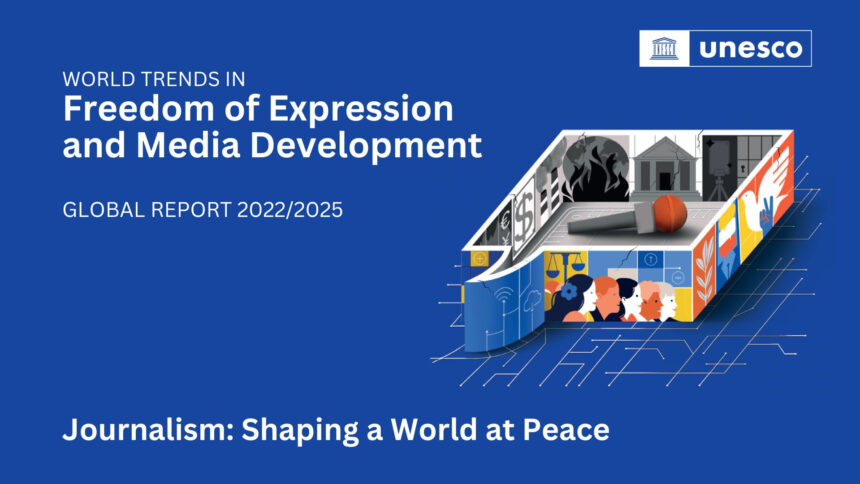
The past 12 years have been marked by a sharp erosion of the democratic check and balances. According to a UNESCO analysis, the Global Freedom of Expression Index fell by 10% between 2012 and 2024 — a historic drop comparable only to World War I, the prelude to World War II, and the late 1970s Cold War.
- Self-censorship has risen an alarming 63%, increasing about 5% per year since 2012, as journalists report avoiding topics like corruption, human rights, and environmental harm. This practice is becoming the new norm for journalists.
- Government media restrictions such as digital surveillance (the monitoring and collection of data on journalists using digital technology) – and abusive legislation or “lawfare” has grown by 48%.
- Journalists also face escalating physical threats, particularly in conflict zones. Between 2022 and 2025, 185 journalists were killed a 67% increase from the previous four years.
- Journalists today face a wide and growing range of attacks—physical, digital, legal, and even those that force them to flee their homes. Environmental reporters are also at heightened risk: UNESCO recorded 749 attacks on journalists covering environmental issues between 2009 and 2023, with a sharp rise in recent years; Women journalists are particularly affected by online violence. According to a major new global survey, developed by International Center for Journalists’ (ICFJ) Research Division for UN Women, in partnership with UNESCO,75% of women journalists and media workers said they experienced online violence while doing their jobs — up from 73 % in 2020.In addition, the proportion of women journalists and media workers who reported offline attacks, abuse or harassment in connection with earlier online threats, doubled from 20% in 2020 to 42 % in 2025.
- Emerging technologies and generative artificial intelligence (AI) are reshaping journalism and public discourse. These tools enable new forms of expression, but they also amplify dis-misinformation, threaten information integrity, and destabilize media business models. In countries with contentious elections, up to 41% of respondents observed a rise in disinformation during campaigns.
- Regression of women rights and of groups in situations of vulnerability and marginalization. Hard-won progress is being rolled back, while violence and harassment against them is on the rise. Out of the 67% of users who encountered online hate speech, 33% identified as LGBTQI and ethnic minorities were targeted.
- Media’s economic crisis. Digital platforms now capture the lion’s share of advertising revenues, while trustworthy, professional outlets struggle to survive. 50% of global ad spending is controlled by only three digital platforms.