

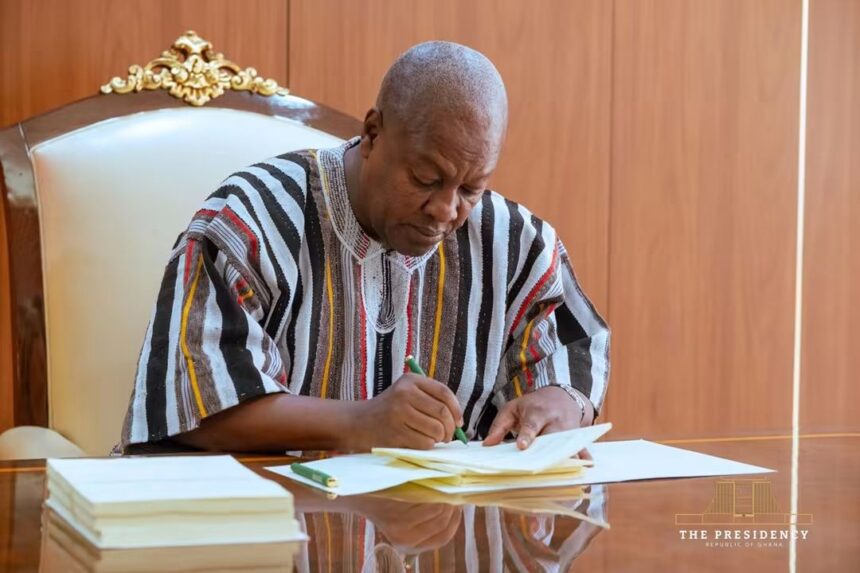
President John Dramani Mahama has assented to 10 Bills passed by Parliament, formally bringing them into law as his administration advances reforms in governance, public administration, justice, national security and economic management.

 John Mahama assents to 10 Bills.
The new laws cover key areas of Ghana’s economy and institutional framework, including customs administration, community sentencing, tribunals, maritime security, defence education, taxation, energy-sector financing and cocoa-sector regulation.
Related Stories

The 10 Bills are:
- Customs Bill, 2026
- Community Service Bill, 2026
- Tribunal Bills, 2026
- Maritime and Related Offences Bill, 2026
- National Defence University Bill, 2026
- Income Tax (Amendment) Bill, 2026
- Energy Sector Levies (Amendment) Bill, 2026
- Ghana Cocoa Board Bill, 2026
- Value Added Tax (Amendment) Bill, 2026
- Excise Bill, 2026
President Mahama said the Customs Act consolidates existing customs legislation into a single framework to make administration more efficient and help close revenue leakages.
The Community Service Act introduces non-custodial sentencing for certain minor offences, providing an alternative to imprisonment and potentially reducing pressure on correctional facilities. The Tribunal legislation is intended to strengthen the framework for regional tribunals, while the Maritime and Related Offences Act provides domestic legal backing for addressing offences committed at sea.
On the economy, the Income Tax Amendment Act exempts minimum-wage earners from income tax, while changes to energy-sector levies seek to address loopholes involving fuel oil. The Ghana Cocoa Board Act incorporates reforms to the cocoa sector, including the government’s commitment to increased local processing and improved returns for cocoa farmers.
The VAT and Excise legislation also introduce changes to Ghana’s tax framework, including provisions affecting gold transactions and incentives for local fruit-juice manufacturers.

The President’s assent marks another significant step in the government’s legislative programme, with the new laws expected to provide a stronger legal foundation for institutional reforms and economic management.