
First-of-its-kind global analysis reveals massive returns from ensuring children can read by age 10
-
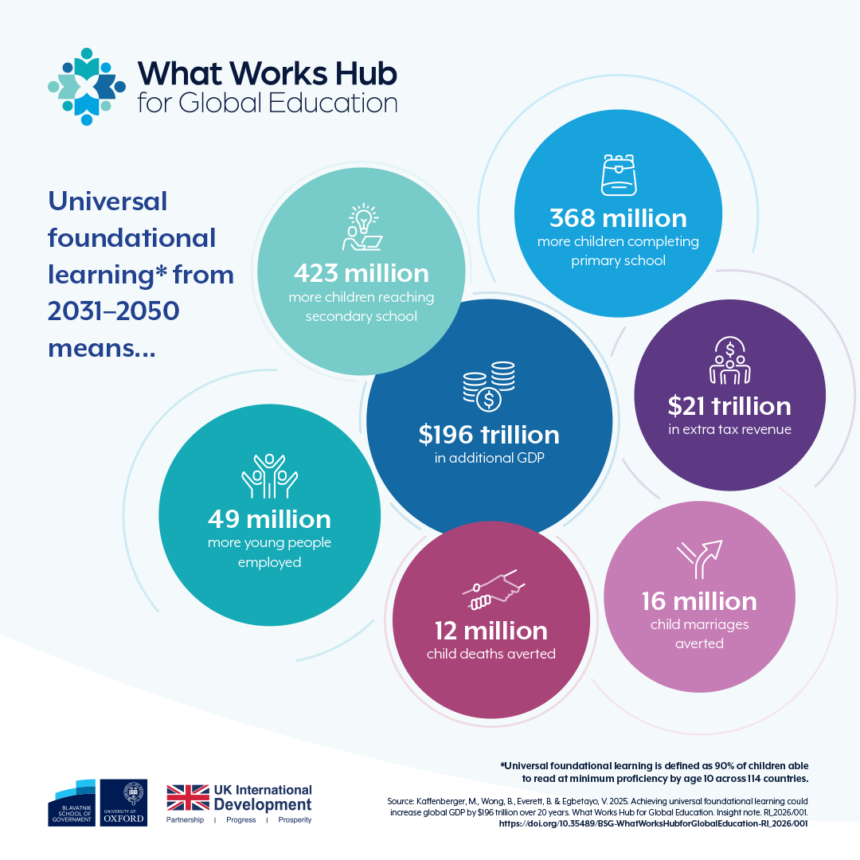
$196 trillion in additional global GDP by 2050, with GDP per capita 27% higher across 114 countries
-
12 million child deaths averted and 16 million fewer child marriages between 2031-2050, concentrated in countries with the lowest development indicators
-
49 million more young people in persistent employment, addressing the global youth unemployment crisis at its roots
-
$21 trillion in extra tax revenue for governments to invest in health, education, infrastructure, and climate resilience
Achieving universal foundational learning could unlock $196 trillion in additional global economic output by 2050, according to groundbreaking research released today by Mettalytics, the What Works Hub for Global Education at the University of Oxford, and the Gates Foundation.
-
The study represents the first comprehensive global modelling of what would happen if 90% of children in 114 countries could read at minimum proficiency by age 10. The analysis spans countries across Sub-Saharan Africa, South Asia, East Asia and the Pacific, Latin America, and the Middle East, with the majority being low and middle-income nations where learning gaps remain largest.
Beyond the staggering economic gains, the research projects 12 million child deaths averted, 16 million fewer child marriages, and 49 million more young people in steady employment between 2031 and 2050.
“This research fundamentally reframes foundational learning from an education issue to an economic imperative,” said Michelle Kaffenberger, Director of Evidence Translation for the What Works Hub for Global Education, University of Oxford. “When children learn to read, entire economies transform. The returns are extraordinary, and they’re largest in low and middle-income countries. Universal foundational learning doesn’t just raise prosperity, it narrows global inequalities.”
Across low and middle-income countries, 368 million additional children would complete primary school, and 423 million would progress to secondary education. Governments would gain $21 trillion in extra tax revenue, providing crucial fiscal space for health, education, infrastructure, and climate resilience investments.
Dr. Obiageli Ezekwesili, Founder and CEO of Human Capital Africa, emphasised the urgency for African leaders: “Africa has the youngest population in the world. This research proves what we have reiterated over and over: investing in foundational learning today is the most strategic decision our governments can make to unlock the continent’s demographic dividend and accelerate prosperity for all Africans.”
The findings arrive as governments face stubborn youth unemployment, declining development assistance, and mounting debt burdens. Country-specific projections reveal transformative potential across the continent and beyond. In Nigeria, universal foundational learning would enable 42 million additional children to complete primary school over 20 years and avert 3.3 million child deaths. Kenya, where only 21% of children currently read at age 10, would see GDP per capita rise 68% by 2050. Ethiopia would gain 3 million more employed youth, while the Democratic Republic of the Congo would avert 1.4 million child deaths.
Outside Africa, India would generate $38 trillion in additional economic output and see 34 million more children in Pakistan complete primary school. Even Vietnam, already at 82% reading proficiency, would gain $738 billion from reaching the 90% threshold.
“The numbers are staggering, and behind every statistic is a child whose future hangs in the balance,” said Dr. Ben Piper, Global Education Director at the Gates Foundation. “We know what works. Structured pedagogy and targeted instruction are two programmatic interventions that deliver the greatest impact on learning outcomes at relatively low cost. And generative AI is providing unique opportunities to enhance these proven approaches. The question is whether we have the political will to act at scale.”
Critically, the benefits would be greatest in low- and lower-middle-income countries, meaning universal foundational learning would both raise prosperity and narrow global inequalities.
Brad Wong of Mettalytics, who led the economic modelling, noted: “This analysis shows that foundational learning is not just the right thing to do morally, it’s one of the smartest economic investments countries can make. The returns dwarf many other development interventions.”